
Ultimate Guide to the Invisible Technologies Meridial Assessment
A complete walkthrough for the Invisible Technologies AI Trainer assessment. Master Critical Thinking, Word Logic, and Abstract Reasoning.
Introduction
The Meridial Assessment is the primary gateway to becoming an AI Trainer at Invisible Technologies. Unlike standard aptitude tests, this is designed to evaluate "Agentic Reasoning"; your ability to break down complex information into logical steps, identify patterns, and adhere strictly to instructions without introducing outside assumptions.
The Golden Rule:
In the Meridial context, if the text or data does not explicitly say it, it does not exist. Do not use outside knowledge.
Meridial tests whether you can reason strictly from the text in front of you, nothing more
- Golden Rule: if the text or data doesn't explicitly say it, treat it as not existing. No outside knowledge.
- Three modules, ~46 minutes total: Critical Thinking (~24 min), Word Logic (~7 min), Abstract Reasoning (~15 min).
- Critical Thinking tests fact verification, spotting insufficient data, judging argument strength, and logical follow-through.
- Word Logic is rapid-fire verbal analogies; define the relationship in the first pair before checking the options.
- Abstract Reasoning rewards a systematic approach: track one visual element at a time instead of the whole image.
1. Assessment Overview
The assessment evaluates three distinct cognitive areas. Understanding the specific goal of each module is critical, as the logic rules change slightly between sections.
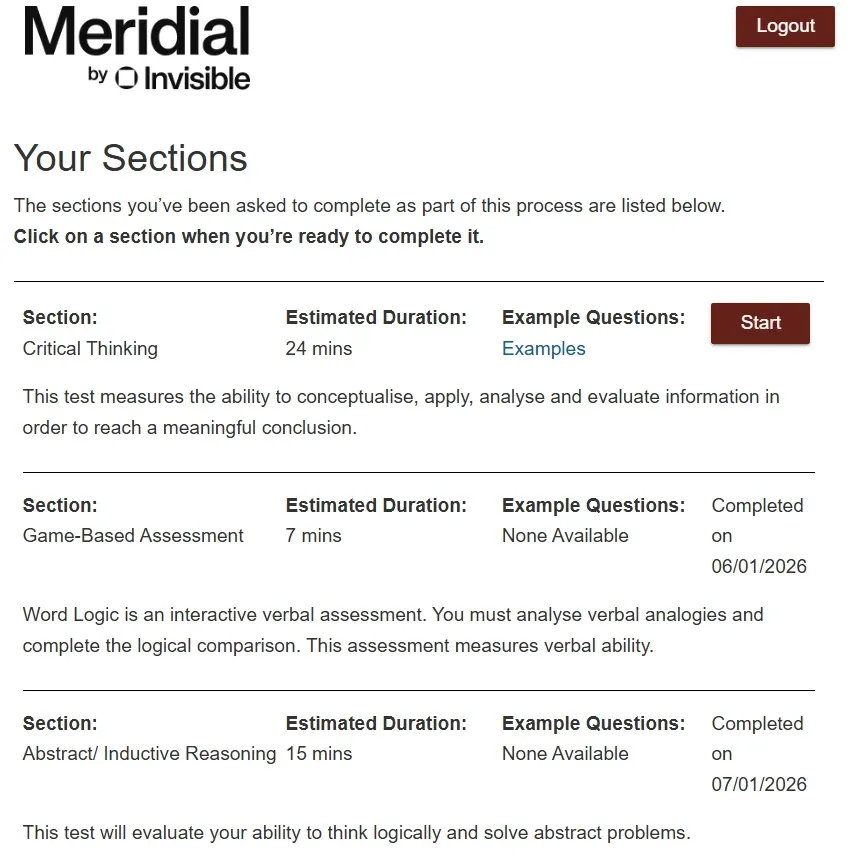
Module I, Critical Thinking (~24 minutes), has you analyze text to find logical fallacies and verify facts based strictly on the provided paragraphs. Module II, Word Logic (~7 minutes), is a rapid-fire test of verbal fluid intelligence using analogies and bridge sentences. Module III, Abstract Reasoning (~15 minutes), has you identify patterns in visual sequences, otherwise known as inductive reasoning.

Module I: Critical Thinking Deep Dive
In this module, you must rely only on the provided text. Below are the four core question types you will encounter, with the full transcripts and analysis.
Type 1: Fact Verification
Transcript
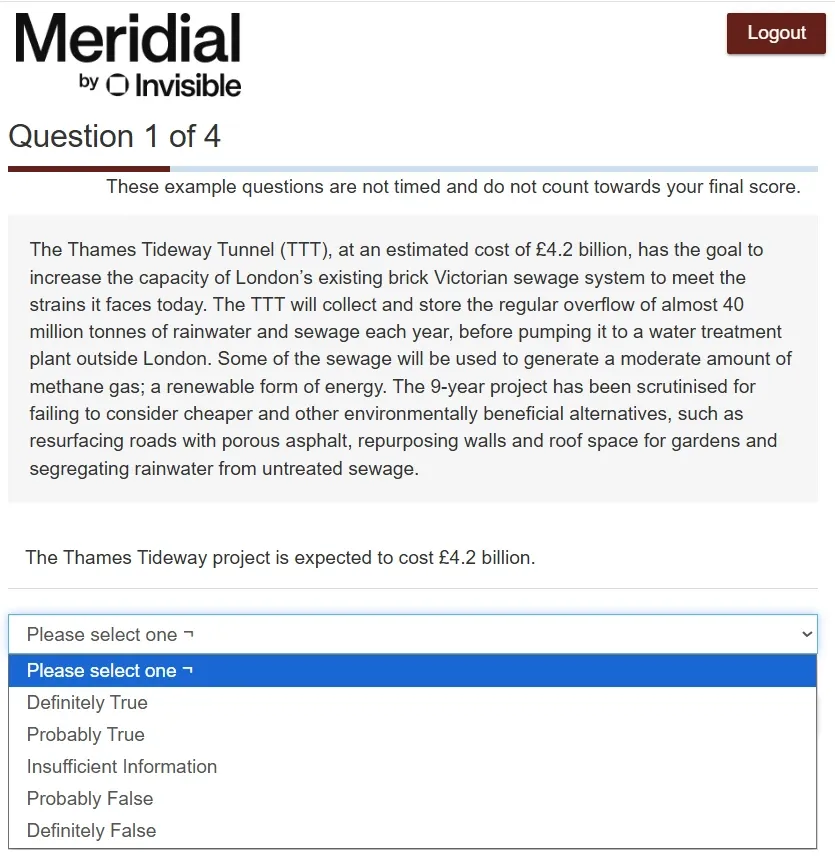
"The Thames Tideway Tunnel (TTT), at an estimated cost of £4.2 billion, has the goal to increase the capacity of London's existing brick Victorian sewage system to meet the strains it faces today. The TTT will collect and store the regular overflow of almost 40 million tonnes of rainwater and sewage each year, before pumping it to a water treatment plant outside London. Some of the sewage will be used to generate a moderate amount of methane gas; a renewable form of energy. The 9-year project has been scrutinised for failing to consider cheaper and other environmentally beneficial alternatives, such as resurfacing roads with porous asphalt, repurposing walls and roof space for gardens and segregating rainwater from untreated sewage."
Statement: The Thames Tideway project is expected to cost £4.2 billion.
Correct Answer: Definitely True
Reasoning: The very first sentence of the passage states: "The Thames Tideway Tunnel (TTT), at an estimated cost of £4.2 billion..." Since the passage explicitly provides this figure as the estimated/expected cost, the statement is directly confirmed by the text.
Type 2: The "Insufficient Data" Trap
Transcript
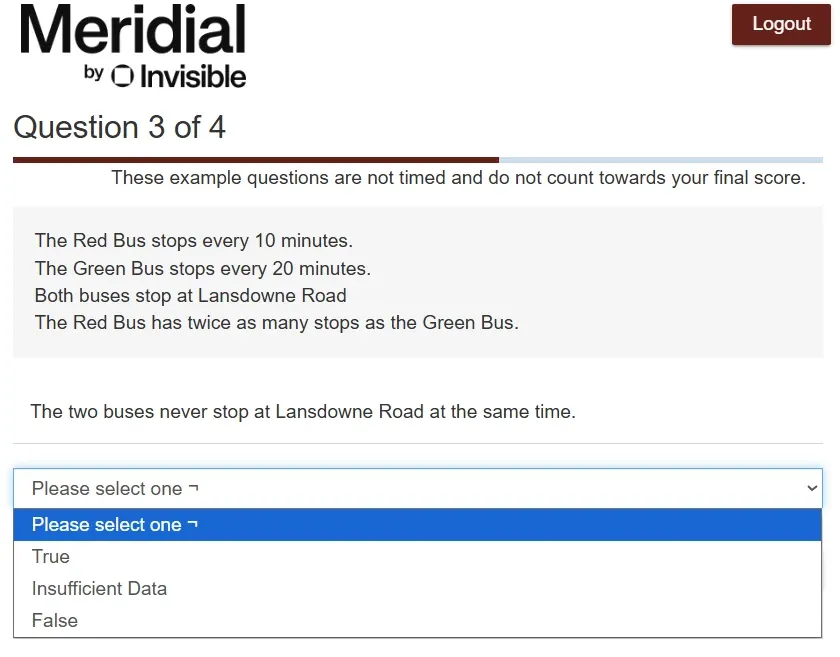
"The Red Bus stops every 10 minutes.
The Green Bus stops every 20 minutes.
Both buses stop at Lansdowne Road.
The Red Bus has twice as many stops as the Green Bus."
Statement: The two buses never stop at Lansdowne Road at the same time.
Correct Answer: Insufficient Data
Reasoning: While we know the frequency (every 10 and 20 minutes) and the location, the text does not provide the start times.
If Red stops at 12:00 and Green at 12:00, they overlap.
If Red stops at 12:05 and Green at 12:00, they never overlap.
Because the passage implies missing schedule data, it is impossible to determine the truth.
Type 3: Argument Strength
Transcript
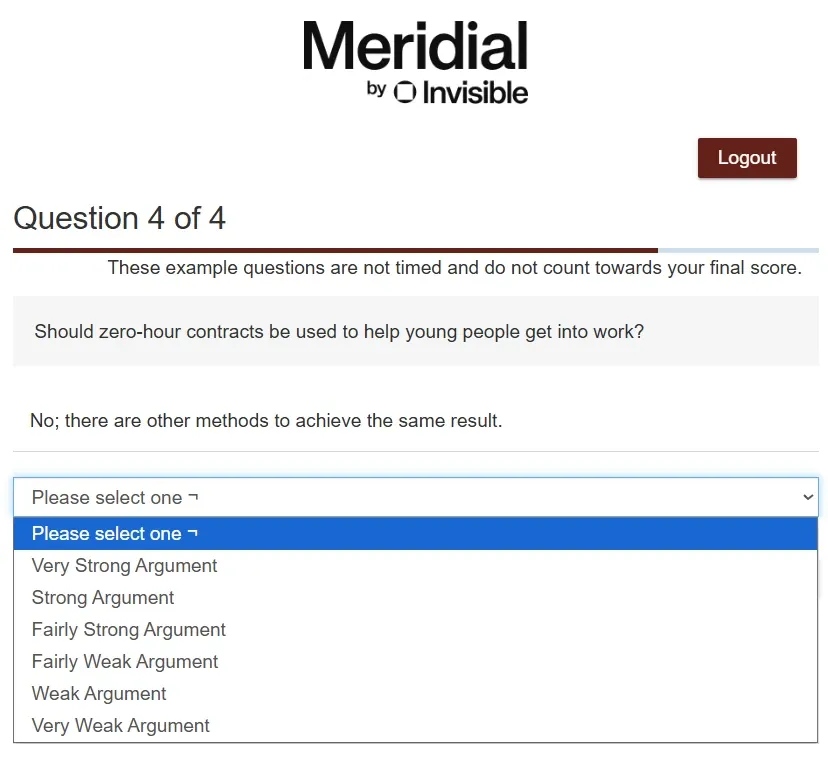
Question: Should zero-hour contracts be used to help young people get into work?
Proposed Argument: No; there are other methods to achieve the same result.
Correct Answer: Weak Argument (or Very Weak)
Reasoning: The argument is vague. It states that "other methods" exist but fails to name them or explain why they are superior to zero-hour contracts. Merely stating that an alternative exists does not constitute a valid argument against the proposed method.
Type 4: Logical Follow-Through
Transcript
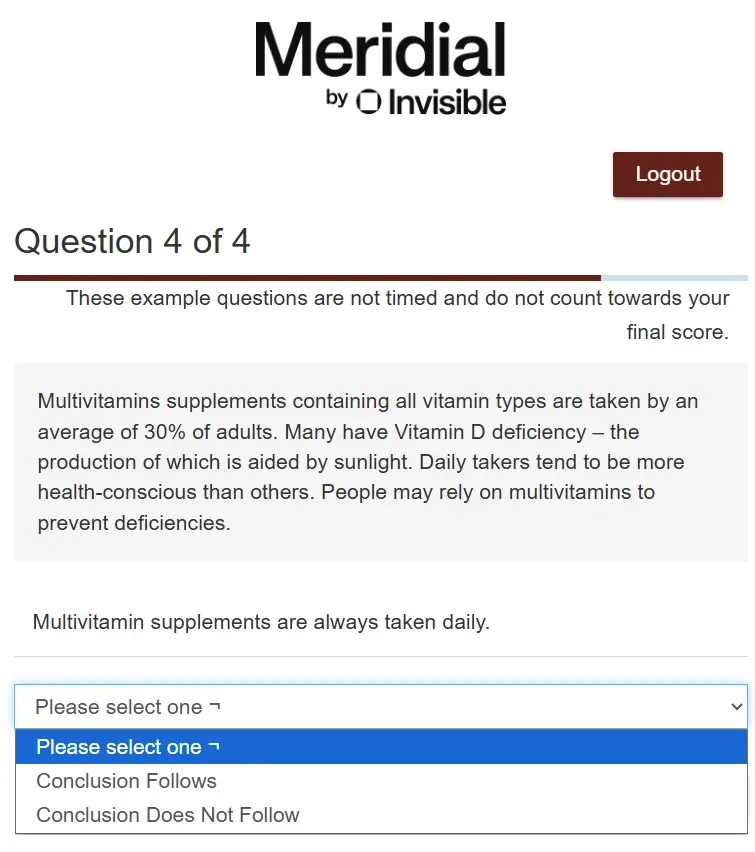
"Multivitamins supplements containing all vitamin types are taken by an average of 30% of adults. Many have Vitamin D deficiency – the production of which is aided by sunlight. Daily takers tend to be more health-conscious than others. People may rely on multivitamins to prevent deficiencies."
Conclusion: Multivitamins supplements are always taken daily.
Correct Answer: Conclusion Does Not Follow
Reasoning: The text mentions "Daily takers," implying that a group of people exists who take them daily. However, the conclusion uses the absolute word "Always." The text does not support the idea that everyone who takes them does so daily; it only describes the habits of those who do.
Module II: Word Logic Strategy
The Word Logic section is a test of Verbal Analogies. You have 7 minutes to complete as many as possible. To solve these, you must define the precise relationship in the first pair before looking at the options for the second.
Example A: Materials
TREE is to PAPER
what SAND is to...
Logic:
Bridge Sentence: A Tree is the raw material processed to make Paper.
Apply: Sand is the raw material processed to make Glass.
Example B: Verb/Noun Forms
BLOW is to HIT
what CRUNCH is to...
Logic:
Key: Both "Blow" and "Hit" are verbs in base form (not "Blowing" or "Hitting").
Similarly, "Crunch" is a verb. The answer must match the form: BITE (not "Biting").
Relationship: Crunch is a specific type/intensity of a Bite.
Test Your Skills
Word Logic Game; Find the relationship









Module III: Abstract & Inductive Reasoning
This assessment is designed to test your fluid intelligence; your ability to identify rules and solve new problems without needing any specific language or prior knowledge. Because you only have 15 minutes, speed and a systematic approach are your best tools.
What is Diagrammatic Reasoning?
Diagrammatic reasoning focuses on logical operators or sequences of shapes that change according to a set of rules. Think of it like "visual algebra." Instead of \( x + y = z \), you are solving:
[Shape A] + [Rule X] = [Shape B]
The core objective is to move from specific observations to a general rule. This is called Inductive Reasoning.
Strategy: The "Single Element" Method
The most common mistake is trying to see the whole image at once. Instead, use the SCANSS Checklist. If you can't see a pattern immediately, ignore the whole picture and track just one element through these criteria:
- S - Shape: Is the shape changing (e.g., triangle to square)?
- C - Color: Is it alternating black, white, or grey?
- A - Angle: Is it rotating clockwise or counter-clockwise?
- N - Number: Are elements being added (+1) or subtracted (-1)?
- S - Size: Is the object growing or shrinking?
- S - Symmetry: Is the image being mirrored or reflected?
15-Minute Success Tips
- Identify Distractors: In many tests, one element might be completely random. If an element doesn't follow a clear pattern after 3 steps, ignore it.
- Eliminate Wrong Answers: As soon as you find one rule (e.g., "The arrow must point Right"), cross out every choice that doesn't fit. You often don't need to solve the whole puzzle to find the answer.
- Pace Yourself: You have less than a minute per question. If you are stuck for more than 45 seconds, guess and move on.
Example 1: Arithmetic Progression (The Dots)
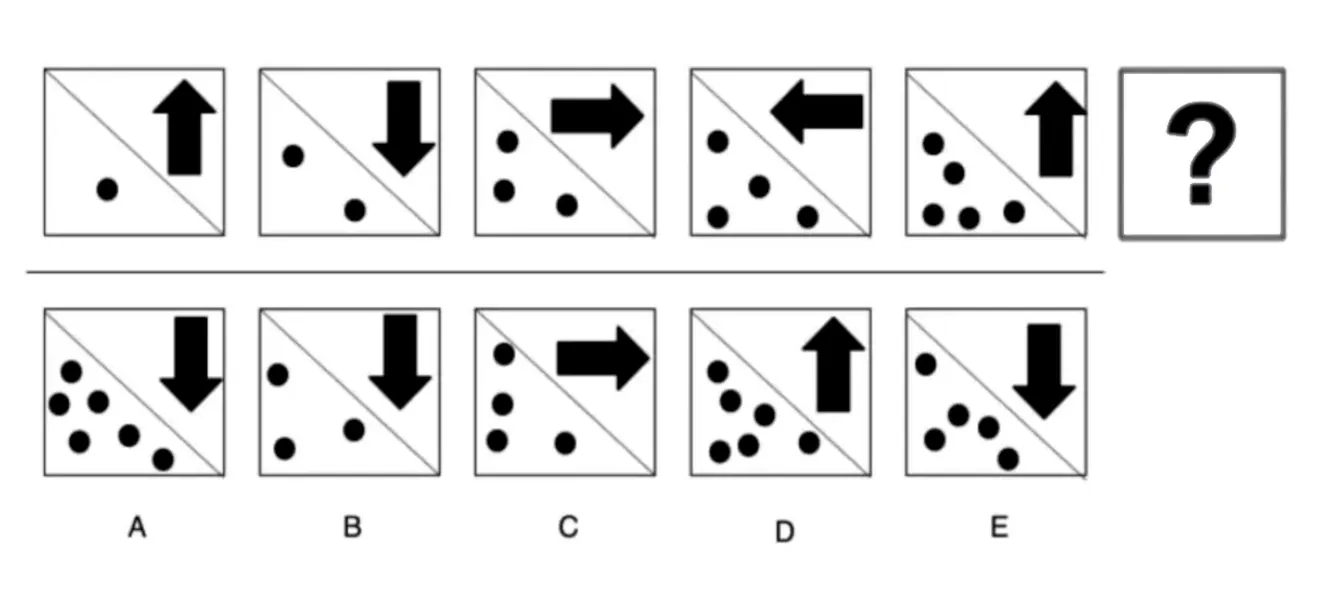
Observation
The pattern involves two distinct elements, but here we focus strictly on the Number of Dots.
- Frame 1: 1 dot
- Frame 2: 2 dots
- Frame 3: 3 dots
- Frame 4: 4 dots
- Frame 5: 5 dots
Solution Logic
Rule: The sequence follows a "Plus One" (+1) arithmetic progression.
Application: The next figure after the 5-dot frame must logically contain 6 dots.
Check Options:
- Option A: 6 dots (Match)
- Option B: 3 dots
- Option C: 4 dots
- Option D: 7 dots
- Option E: 5 dots
Example 2: Rotation & Orientation (The Arrows)
Observation
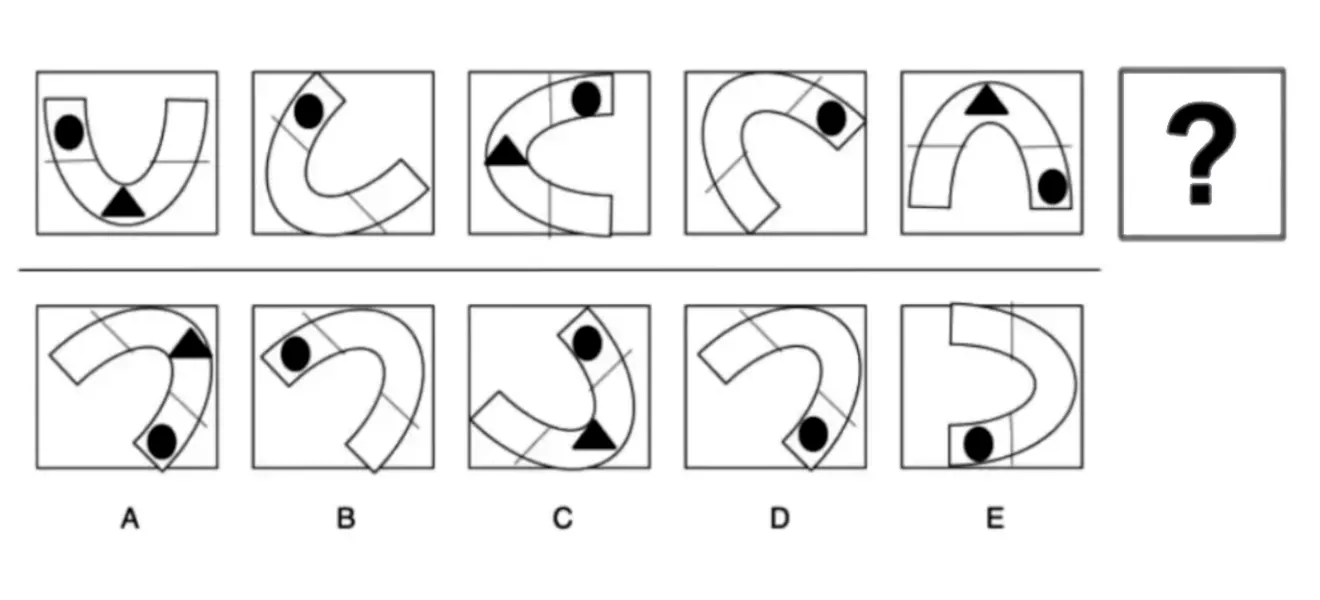
We now isolate the Arrow element to check for rotation or orientation rules.
Sequence: Up \(\rightarrow\) Down \(\rightarrow\) Right \(\rightarrow\) Left \(\rightarrow\) Up.
Solution Logic
Rule: The arrow follows a specific cycle or alternating pattern. Note the relationship between the start and end of the sequence.
Vertical Relationship: If we look at the transition from the last box of the top row (Up) to the first box of the potential answer (Bottom A), we see it flips to Down. This mirrors the very first transition in the sequence (Box 1 Up \(\rightarrow\) Box 2 Down).
Final Conclusion:
Option A is the correct choice because it satisfies both rules simultaneously:
- It follows the arithmetic progression of dots (5 + 1 = 6).
- It maintains the alternating vertical orientation (Up/Down) established at the start of the sequence.
Explore Other AI Platforms
Finished the Meridial? These platforms are also hiring AI Trainers right now.





Have a degree or specialized domain expertise?
SME Careers recruits subject matter experts (Law, Medicine, STEM, Coding) to train advanced AI models. These roles pay significantly more than standard "task" work.
Frequently Asked Questions
What is the Meridial Assessment testing for? ▼
It evaluates "Agentic Reasoning": your ability to break complex information into logical steps, identify patterns, and follow instructions strictly without introducing outside assumptions or knowledge.
How long does the assessment take? ▼
Roughly 46 minutes total across three modules: about 24 minutes for Critical Thinking, 7 minutes for Word Logic, and 15 minutes for Abstract Reasoning.
Can I use outside knowledge to answer questions? ▼
No. The core rule across the assessment is that if the text or data provided does not explicitly say something, you must treat it as not existing. Answers based on facts you know but that are not stated in the passage will be marked wrong.
What does "Insufficient Data" mean as an answer choice? ▼
It means the passage does not give you enough information to determine whether a statement is true or false, even though it might seem plausible. Picking "definitely true" or "definitely false" when the text simply doesn't say is one of the most common mistakes.
What is the best strategy for the Abstract Reasoning module? ▼
Use the "Single Element" method: instead of trying to see the whole image pattern at once, track one element at a time (shape, color, angle, number, size, symmetry) through the sequence using the SCANSS checklist, then eliminate answer options that break the rule you found.
Is the Meridial Assessment the same for every Invisible Technologies role? ▼
The three modules (Critical Thinking, Word Logic, Abstract Reasoning) are consistent, but which roles require it and how heavily each module is weighted can vary. Treat this guide as prep for the assessment format itself, not a guarantee of identical content every time.
Specialist Domain Expert Jobs Hiring
Found 1 job matching "Specialist"

Related guides
Best AI training platforms compared: where to apply once you understand what assessments look for.
How to become an AI trainer: the full application and onboarding path from first assessment to first task.
SME Careers assessment guide: deep-dive on one platform's full assessment flow.
What are rubrics in AI training?: the scoring framework that assessments are testing you on.
What is AI training?: full beginner overview of the field and how to get started.
Cite this page
"Ultimate Guide to the Invisible Technologies Meridial Assessment", aitrainer.work, aitrainer.work/guides/invisible-logic-assessment

MSc Human-Computer Interaction | Founder
Pietro is the founder and technical lead of aitrainer.work. He builds and maintains the platform's data pipeline, certification infrastructure, and editorial standards.