
My Ethos AI Interview Call Experience (2026)
I took the AskEthos AI voice interview, what tripped me up, the roles that showed up in my dashboard, how the eventual screening call went, and the result that came back weeks later.
On May 4th I put in headphones and talked to an AI about my career for 25 minutes. A few hours later I called back and did it again, faster and sloppier, to see what would change. Here's how both calls went, and what turned up in my dashboard a couple of months later.
I'm a UX researcher, so sitting down and asking people questions is basically my day job, and I run this site after my own long search for AI training and expert-network work. So I went in curious about how the call would hold up. Short version: it went better than I expected, and I'd tell someone in my position to take it.
AskEthos is an expert network, and this call is the whole of how they get to know you before they start matching you to work. That's why I wanted to see what it asked.
What happened
- Block out more than five minutes. The profile page says five, my call ran 25, and the longer one is the one that paid off.
- The questions were good. It pushed past my vague answers and asked for real examples, the same way I would interviewing someone.
- Ending the call took a couple of tries. Nothing serious, just be direct when you're done.
- My first profile didn't save, so I called back the same day and covered it again. Short repeat calls are easy to do.
- When I rushed and read my CV at it like a list, I got a thin profile back. Talk to it properly and it goes digging.
- Two roles showed up later at $70-$80/hr, right in line with what Ethos pays across its live listings, and both named where I didn't quite fit.
- A later match fit my field exactly, and I took that screening call. It went well. The result, a couple of months on: not selected, the client went with other candidates.
Latest Ethos Expert Opportunities
Showing the 6 latest open roles


Pitch Deck Specialist Expert
$70-90
/hr
Restructuring Director Expert
$90-120
/hr
Insolvency Practitioner Expert
$90-120
/hr
The first call ran far longer than the five minutes it promises
Your profile page sets the expectation before you open a call: "This page is my portrait of you, talk to me for five minutes and I'll sharpen it." Mine ran 25 minutes, and I opened a second one later that day, also 25. I'd read the five minutes as the floor rather than the ceiling. You can top your profile up in short bursts whenever you want, but the long first call is the one that does the heavy lifting, so give it a proper slot in your day.
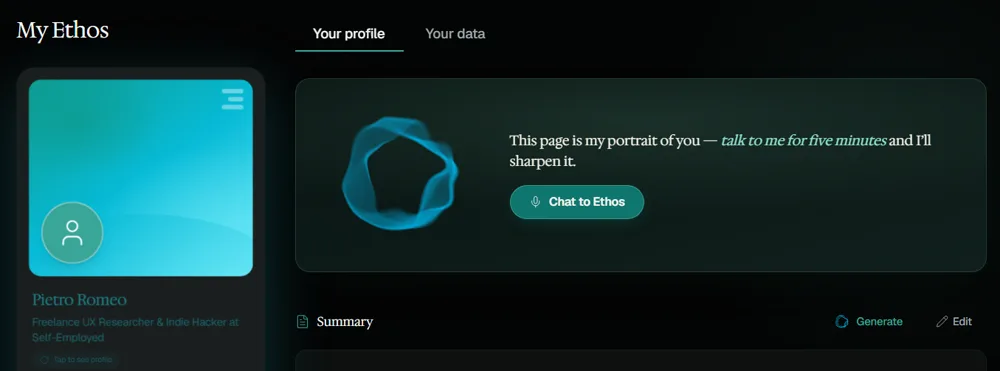
It opens by introducing itself as "your AI agent that matches you to infinite opportunities" and asks how you got into the work you do. I gave it the real answer: what I trained in, how I moved from evaluative research into more exploratory work, and what I do now. It let me finish before asking anything back, which already put it ahead of a few human interviews I've sat through.
A few minutes in, I'd been talking in fairly abstract terms about the kind of research I like, the stage before a product exists rather than testing one that's already built. It didn't just nod along.
From the transcript
Ethos: "Can you walk me through one specific moment where you realized 'this early, exploratory work is the lane for me'?"
That's a good question, and it's the one I'd have asked too. So I gave it a real story: a fieldwork project where something I found changed how a team read a market they'd been struggling with. Then it went straight for the part that counts:
From the transcript
Ethos: "What was the specific decision or change that happened because of those findings?"
Not "how did that feel" or "what did you learn," but what changed because of you. That's the kind of detail a client can search for and find you by, which is the whole point of having a profile there at all.
The part that surprised me
Every follow-up built on something I'd already said. It never asked me to repeat my job title back at it, and when I described a shift in the kind of work I focus on, it brought that back accurately several exchanges later without me prompting it. For a good stretch, it was doing a decent version of what I do for a living.
That's worth saying plainly, because it's the kind of interview a resume form can't give you. A job title tells a client nothing. A project with a real outcome attached to it is something they can go looking for.
Ending the call takes more effort than starting one
Twice it started a sentence and cut itself off mid-word before moving on: "That arc is really distinctive, when you say 'research". Small stuff, and it didn't get in the way.
Wrapping up took more effort. I'd said what I came to say and told it so:
From the transcript
Pietro: "Well... Oh. I think I will end this call now."
Ethos: "Got it, Pietro, thanks for pushing this through. And what part of the work you've been doing lately are you most done with?"
"Got it," and then another question in the same breath. I tried again and it came back with a clarifying question of its own. Third time, a flat "Okay. I have to go now," and it let me go. So just say it plainly when you're finished, and say it twice if you have to. That's the only piece of the call I'd warn anyone about, and it's a small one.
I rushed the second call and it showed
A few hours later I called back, because what I'd said in the first call hadn't landed in my profile. No idea whether that was a save issue or a sync delay. Either way, calling back took a couple of minutes, which is what those short top-up calls are for. I opened with it straight:
From the transcript
Pietro: "I just want to share my background with you 'cause this did not get saved properly in the profile, and I'll just go through it, and then you just end this call."
Then I did the thing our own prep guide tells people not to do: I read my history at it, fast, in a list. Dates, institutions, roles, a job title it had clearly never heard before. All true, all relevant, and none of it turned into a question. It thanked me and hung up.
Same person, same day, same system, two very different profiles. The difference was how much I gave it to work with, which is the one thing I'd pass on to anyone about to take the call. Treat it like a conversation and it does the rest.
What showed up in my dashboard
A couple of months later, two matches appeared under "In motion": an $80/hr tech product-manager role and a $70/hr market-research and consumer-insights role, both remote and asynchronous, both already marked "Interested" with a screening call as the next step. Both land in the same $70-$80/hr band our own data shows as the median across live Ethos listings, so nothing was inflated to look good on a dashboard.
What I didn't expect was that the "why you're a match" write-ups didn't sugarcoat anything. Each named my strengths, research background, cross-functional work, structured projects, and then named the gap in the same breath: one said my background is research rather than product management, the other noted I didn't have the multi-year tenure at one company the role wanted. Neither gap stopped the match going through. Both still offered a screening call and a "Start interview" button, which is a good sign if you're worried your CV doesn't look tidy enough to bother.
I didn't take either call, and that's on me rather than on the roles. They were real, priced in line with what our data tracks, and upfront about the fit. I'm a UX researcher rather than a product manager or market researcher, and I'd sooner flag that myself than let a client find out on a paid call. They were real enough that taking them felt like a genuine option, which is more than I can say for most "you've been matched" emails. What did change my mind was a later match that fit exactly, more on that below.
More calls let me steer it toward the work I wanted
A few weeks later I went back for two more calls, 47 minutes and 36 minutes, mostly because the first two matches were adjacent to my field rather than in it, and I wanted the profile to reflect what I do best: generative UX research and service design, not UX broadly. So on the second of those calls, I said so outright instead of waiting for it to ask.
From the transcript
Pietro: "I just wanted to talk more about UX research, because you keep matching me to roles that are relevant to my skills, but not to what I exactly, um, best at and what I do want to find, which is, you know, generative UX research and service design. So, why don't you ask me about that?"
Ethos: "That makes total sense... What are the last one or two generative studies or service-design activities you led where you felt most 'in your element'?"
It pivoted immediately and stayed there, pulling out two full case studies with real outcomes attached, ethnographic fieldwork in Sicily for FlixBus, a two-week engagement for a Finnish retailer. You can redirect it mid-relationship, across calls, and it holds the correction. Partway through, it stopped asking for the story and started asking for the artifact underneath it:
From the transcript
Ethos: "...did you use a specific artifact (journey/service blueprint, segmentation framework, opportunity map), a workshop format, or a 'decision memo' style presentation?"
That's the same instinct that showed up later in the screening interview, below: past the summary, into what you produced. If you're prepping for one of these calls, have your deliverables ready to name, not just the project.
I took a screening call after all
Those extra calls eventually surfaced a match that fit a lot better than the first two: an Expert Opportunity for a Customer/User Researcher, which is the actual job I do rather than an adjacent one. This time I took the screening interview.
It had the same vibe as the AI calls before it, share your relevant past work, and this interviewer wanted more of the practical detail than usual, deliverables I'd shipped rather than just the shape of a project. Nothing about it was a hard question, and everything stayed inside my field. Overall a good experience, and the kind of call worth taking once a match lines up with what you do.
The result came weeks later, on September 6th: not selected. The email was upfront that the delay was on their side, "unprecedented volume of expert interest," and that the client went with a different set of candidates for that project. Nothing about my call, just more experts in the pool than roles on that particular one.
The same email pointed out that my profile stays live and keeps getting matched against new work coming in, expert calls, advisory roles, consultancy, full-time roles, not just the one project I screened for. A screening call that goes well can still end in a no, and the profile behind it doesn't reset because of it.
So is it "harvesting your expertise"?
This is the thing people ask most when they search around for AskEthos: the worry that the interview is a way to get free expertise out of people who think they're applying for paid work.
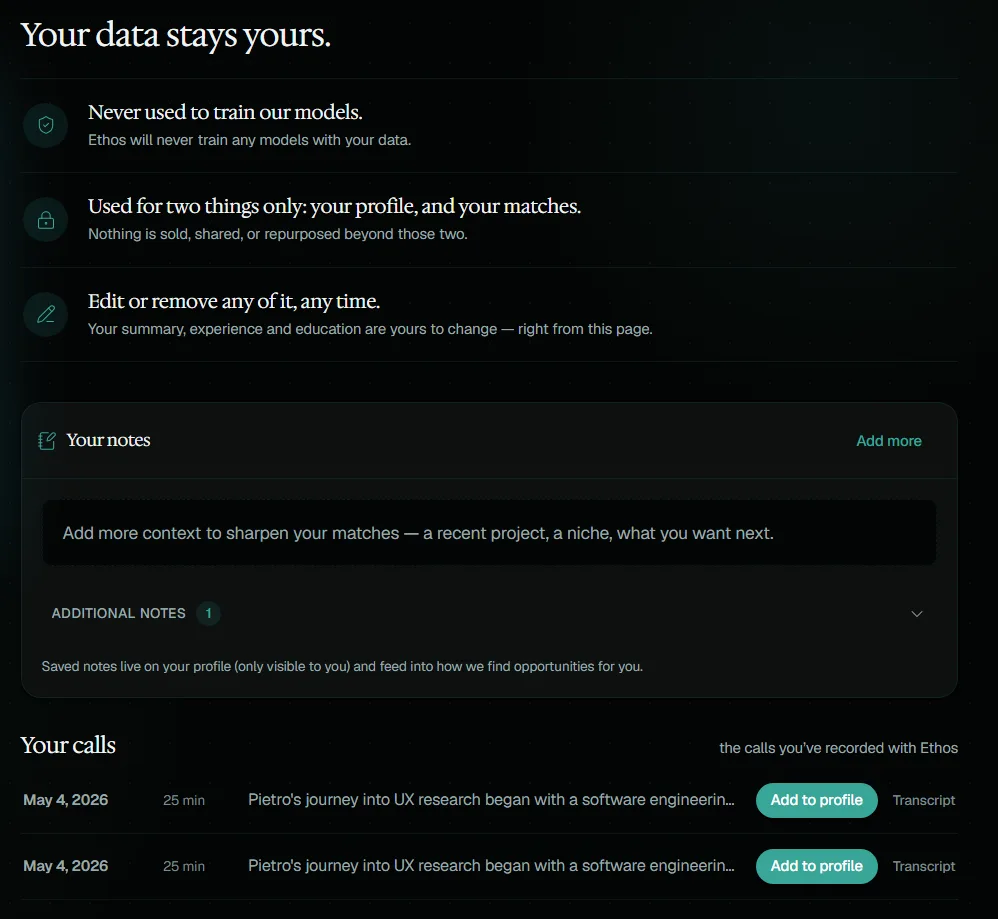
From two full calls, here's what I can tell you: I was never asked about a current employer, a client, or anything non-public. The questions were about what I know how to do and where I've done it, not about solving someone's problem for free on the call. Ethos puts the same thing in writing in the "Your data stays yours" panel I screenshotted above: your data isn't used to train their models, it's for your profile and your matches, and you can edit or delete anything you've shared, past calls included.
The fairer worry is about outcome rather than process: whether a call turns into paid work or just a nice profile nobody looks at. I can answer that now, both sides of it. Real roles at real rates landed in my dashboard, and once one lined up with my actual field, I took the screening call and it held up: a real conversation about real work, no gotchas. Weeks later that specific project went to other candidates. Nothing about the call felt like it was extracting anything for free, it just didn't end in a placement this time. At its best the AI call felt like a real interview with someone paying attention, and at its clumsiest it felt like a voicemail that interrupts you.
Would I tell a friend to take the call?
Yes, with one warning about saying goodbye twice. The call costs you half an hour and gets you a profile that clients can search, and the questions were good enough that I stopped thinking of it as a form partway through.
What stuck with me is how much the result came down to what I brought to it, the same as any interview. Rush it, like I did the second time, and you get a thin profile. Give it something real and it goes looking for the detail underneath.
A couple of months later, two roles in the $70-$80/hr band were sitting in my dashboard waiting on a screening call. That's a decent return on one conversation, and if you're in this kind of work, it's worth finding out what lands in yours.
And it kept going: a few more calls to fill out my profile eventually surfaced a match squarely in my own field, and the screening call for that one held up just as well as the AI conversation that got me there. The more you put into the profile, the better the matches get, which is the whole loop working the way it's supposed to.
Update: that particular project went to other candidates. I'm not going to pretend that doesn't sting a little, but the profile and the matching keep running regardless, and I'd still make the same call again. The loop is real even when a given match isn't the one that lands.
FAQ
Does the Ethos AI interview only take five minutes? ▼
That's the framing on your profile page: "talk to me for five minutes and I'll sharpen it." My first call ran 25 minutes. Think of five minutes as the minimum to get started, not the cap. Give it more and you get a fuller profile back.
Is the Ethos AI interview a real conversation, or scripted? ▼
It's a real back-and-forth. In my call, the AI built its follow-up questions off what I'd just said rather than working through a fixed list. When I answered something vaguely, it asked me for a concrete example instead.
Can you end the AskEthos call whenever you want? ▼
You can, but it took me a few tries. I said I wanted to wrap up and it kept the conversation going with another question. Just be direct and repeat yourself, and you're out. Ending early costs you nothing: you can open another call whenever you like and pick up where you left off. I did four calls in total. After you hang up, check your profile page to confirm what you said was saved.
What happens if your Ethos profile does not save properly? ▼
It can happen. My profile from a first call hadn't saved by the time I opened a second one the same day. If it happens to you, just open another call and say what's missing. Short top-up calls are the whole idea.
Does the Ethos AI interviewer ask follow-up questions on a CV recitation? ▼
In my case, no. When I read out degrees, dates, and job titles like a list, it took the list as-is and closed the call. Talk to it like a person and you get a much better profile out of it.
Will the Ethos AI get your name right if it is not an English name? ▼
Not always on the first try. In one of my later calls it had been mispronouncing mine for a while, so I called back specifically to correct it, and it took the correction and moved on. To be fair, plenty of human interviewers stumble on a foreign name too. Worth knowing either way: it can mishear it early on, and you can just call back to fix it.
Does Ethos only match you to roles that are a perfect fit? ▼
No. Both matches I got named where I fell short alongside my strengths, and still routed me to a screening call. You don't need to look perfect on paper to see real roles show up.
Did passing the Ethos screening call get you placed on the project? ▼
No, not this time. My screening call for a Customer/User Researcher role went well, then weeks later I got an email saying the client had gone with other candidates, citing higher-than-usual expert interest rather than anything specific to my call. The email also said my profile stays active and keeps getting matched to new opportunities regardless. A good call is not the same thing as a placement.
Related guides
Ethos AI interview prep guide: what to have ready and what to say before you take the call.
Ethos review: full platform breakdown covering pay rates, how matching works, and who qualifies.
Browse live Ethos job listings: current expert opportunities updated regularly.
Ethos platform intel: active projects, pay data, and expert network reports.
Cite this page
"My Ethos AI Interview Call Experience (2026)", aitrainer.work, aitrainer.work/guides/ethos-ai-interview-experience

MSc Human-Computer Interaction | Founder
Pietro is the founder and technical lead of aitrainer.work. He builds and maintains the platform's data pipeline, certification infrastructure, and editorial standards.