
My Silencio AI Voice Recording Experience (2026)
I signed up for Silencio, recorded keywords, monologues, and free-speech clips in Italian, and got my data approved a few hours later. Here is what the tasks are like, and whether the $10-20/hr USDC pay is worth it.
Silencio pays people to record their own voice for AI training data. I signed up, recorded keywords, a monologue, and a free-speech answer, all in Italian, and had my data approved a few hours later. Here's what the tasks are like, what the review process involves, and whether the pay is worth your time.
I run this site after my own long search for AI training work, so I go into most of these platforms expecting either a scam or a slog. Silencio was neither. Signing up was extremely easy, and the tasks themselves are simple and kind of fun, but it feels more like a side gig than actual work, and the pay reflects that.
What happened
- Sign-up was frictionless. No lengthy application, no assessment gate before you can start recording.
- Three task types: single-word Keywords, read-aloud Monologues, and open-ended Free Speech prompts, all timed and tracked against a running progress bar.
- 10 minutes of recorded audio is the review threshold. I hit it, submitted, and got approved a few hours later.
- Approval isn't payment. It just makes your data eligible to be sold to clients. USDC only triggers once a client buys it, and Silencio can't tell you when that happens.
- Pay is advertised at $10-20/hr USDC, below typical data-annotation rates, which tracks given how much simpler the work is.
- Regional and non-standard accents seem to face less competition, worth knowing if you don't have a "neutral" accent in your language.
Silencio pays you to record your own voice, not to review other people's data
Silencio is a voice and audio data platform. Contributors record voice clips through the "Train AI" tab of its dashboard, and Silencio packages that audio into datasets it sells to AI labs building speech recognition, voice agents, and other audio-facing models. Contributors get paid in USDC once their data is purchased.
It isn't data annotation or model evaluation in the usual sense you'll see elsewhere on this site: you aren't labeling images, reviewing model outputs, or writing anything. You're just talking, which is both the appeal and the reason the pay sits lower than most platforms we cover.
Silencio's own pitch to contributors is that most voice AI today only reliably handles a small slice of the world's languages, so recordings in less-represented languages, dialects, and accents are what these datasets are short on. That lines up with what I noticed doing tasks in Italian, see below.
Signing up was the easy part
There's no resume, no portfolio, no domain assessment to clear before you can start. You create an account and land straight in the dashboard, with the "Train AI" tab already flagged as the place to earn. Compared to the assessment gates on platforms like Outlier or the interview screens on expert networks, this is about as low-friction as onboarding gets.
The three task types
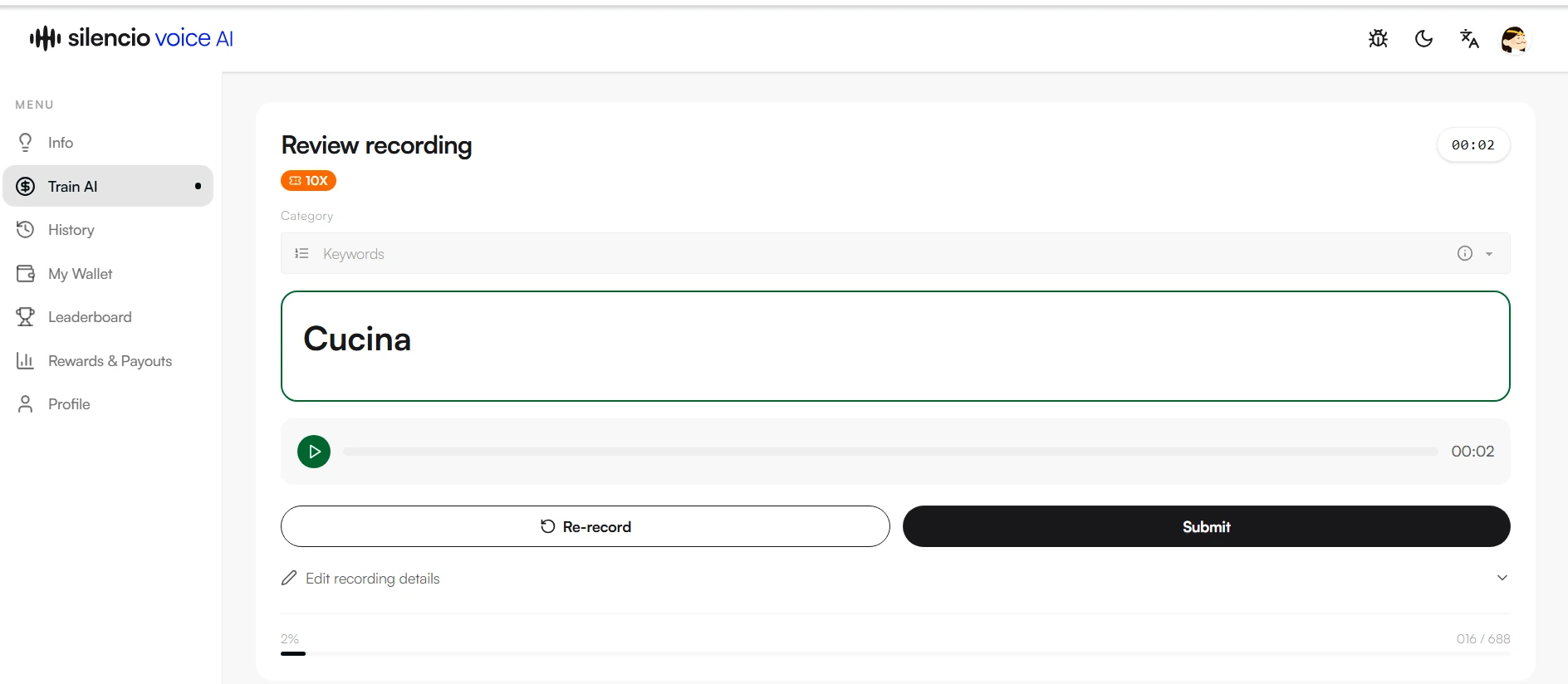
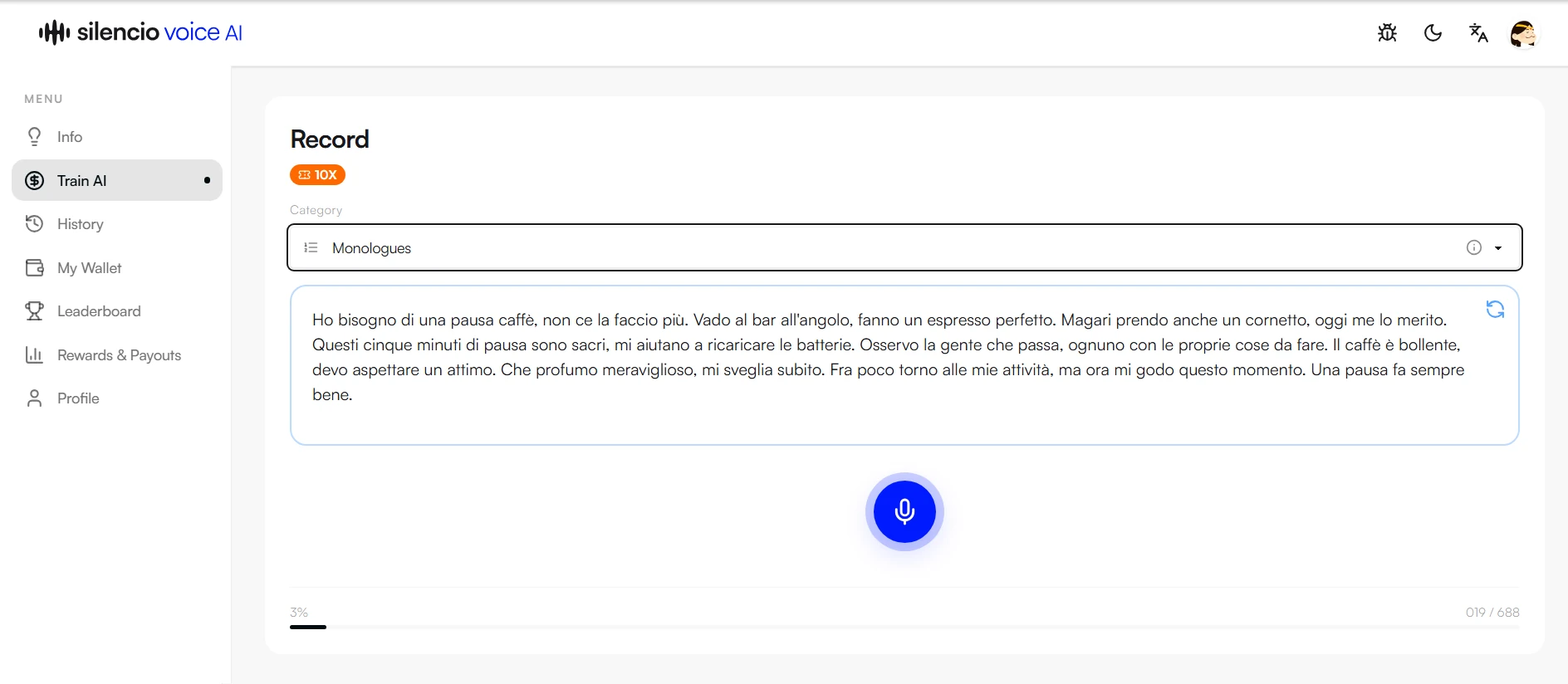
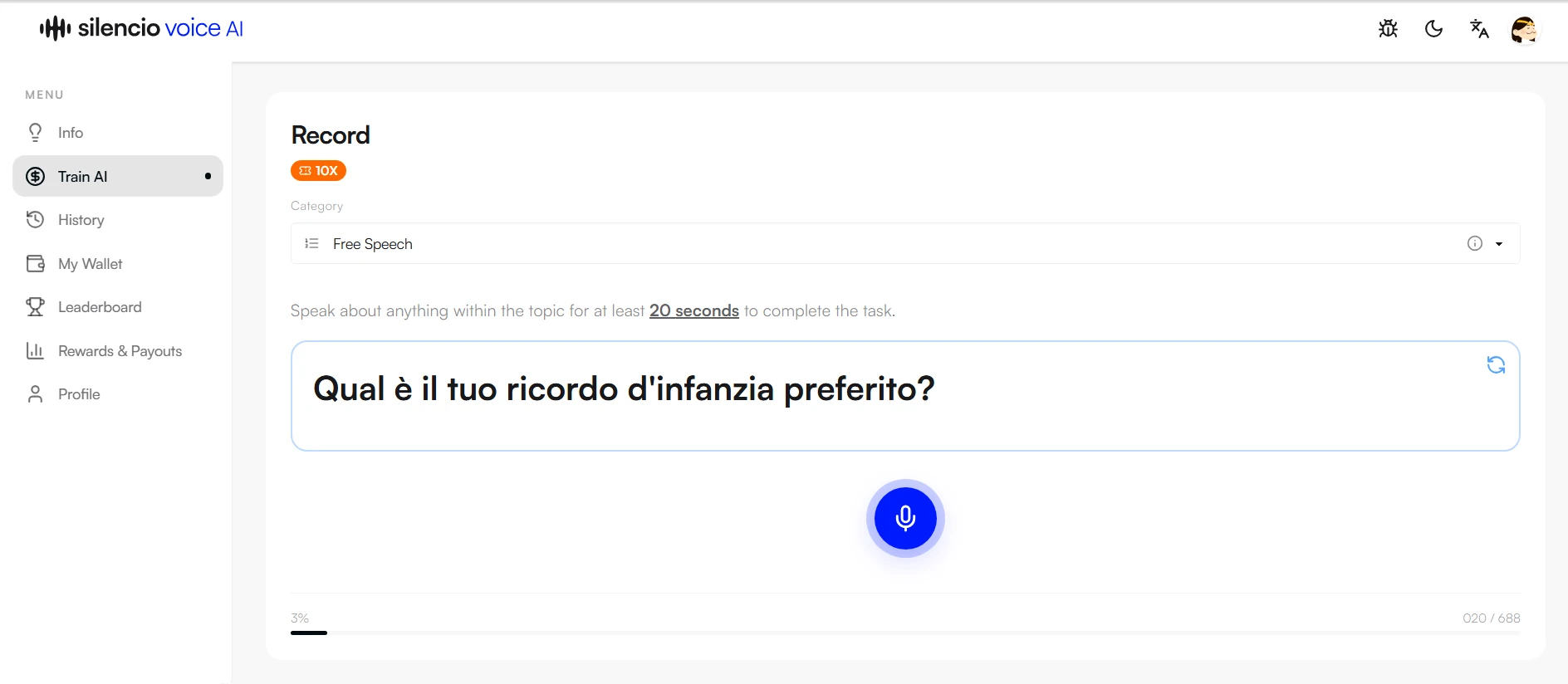
Every recording task falls into one of three categories, each shown with a running completion counter (mine sat around 016-020 out of 688) and, on some tasks, a "10X" bonus badge for higher-value recordings.
Keywords
Say a single word or short phrase clearly, then review the waveform before submitting. Mine was the Italian word "Cucina" (kitchen). Fastest task type by far.
Monologues
Read a full paragraph out loud, on-screen, word for word. Mine was a short Italian passage about taking a coffee break. This is the closest thing to "work" among the three types since it takes the longest and demands the most consistent delivery.
Free Speech
Answer an open prompt in your own words for at least 20 seconds, no script. Mine asked (in Italian): "What's your favorite childhood memory?" This is the most conversational of the three, and the closest to how the audio would sound to a voice model in the wild.
Across all three, the work is simple and a bit fun: there's no wrong answer, no rubric to satisfy, just clear, natural speech. That said, it doesn't feel like "work" the way debugging code or evaluating model outputs does. It's closer to a side gig you do half-focused with headphones on.
I recorded 10 minutes and was approved a few hours later
Silencio requires at least 10 minutes of recorded audio before your data qualifies for internal review. Their stated guidance for getting approved: speak clearly and naturally, avoid background noise or echo, and don't use synthetic or AI-generated voice tools. A team they describe as "audio forensics analysts" checks recording quality, and Silencio notes that review time varies with volume, with higher-tier accounts reviewed faster.
I crossed the 10-minute mark, submitted, and a few hours later got this:
From the notification
"Congratulations. Your internal review was successful and your recordings have been approved. Your data is now eligible to be offered to clients. We will notify you as soon as a client purchases your data and USDC rewards are triggered. Please note that the timing of client purchases cannot be determined by Silencio, as it depends entirely on client demand and specific project requirements."
That last part matters: approval is not payment. It puts your recordings in the pool a client can buy from, but Silencio is explicit that it doesn't control if or when that happens. Worth going in with that expectation set correctly rather than assuming USDC lands the moment you're approved.
Pay lands at $10-20/hr and sits below data annotation
Silencio advertises roughly $10-20/hr in USDC, which is meaningfully below what most data-annotation and evaluation platforms on this site pay. That tracks, though: recording your own voice takes far less cognitive effort than labeling data, writing evaluations, or reviewing model outputs. You're trading a lower ceiling for close to zero ramp-up.
If you're comparing this to Outlier, Mercor, or Micro1 as a primary income source, it doesn't hold up. If you're looking at it as something you can do in the background while doing something else, the math reads differently.
An accent is an advantage here
One thing stood out doing this in Italian rather than English: it felt like there's less competition if you have an accent, even a regional one within your own language. Voice models are hungriest for exactly the audio that's underrepresented in existing datasets, so a non-neutral accent looks like less of a liability here than it would on, say, a customer-facing gig.
If English (or whatever language you'd record in) isn't your first language, or you speak with a strong regional accent, that's arguably a reason to try this rather than skip it.
Would I tell a beginner to try it?
Yes, with the expectations set correctly. Silencio isn't a way to replace real income: the hourly rate is below what data-annotation and expert-network platforms pay, and payment depends on a client buying your data, not just on getting approved. But the sign-up is frictionless, the tasks are quick and low-stress, and there's essentially no floor of experience required.
Where I'd point someone toward it: as a first taste of paid AI-training work before moving on to higher-paying platforms that do require an application or assessment. It's a reasonable way to get comfortable with the idea of getting paid for this kind of contribution, especially if you don't have a "standard" accent and would otherwise assume that counts against you.
Want to try it yourself?
Sign up, record 10 minutes of clear audio, and see what your review comes back as.
Start Recording on Silencio →Affiliate link: we may earn a referral fee at no cost to you. See our disclosure.
FAQ
What is Silencio AI?
A voice and audio data platform that pays contributors to record short voice clips (single words, read-aloud paragraphs, and free-speech answers), which get sold to AI labs training speech and voice models. Payment is in USDC.
How much does Silencio pay?
Pay is advertised around $10-20/hr in USDC. That is lower than most data-annotation gigs, but the work is also simpler: you are just talking into a microphone, not labeling data, coding, or writing.
How does approval work on Silencio?
You need at least 10 minutes of recorded audio before your data goes to internal review. A team Silencio calls "audio forensics analysts" checks recording quality. I got approved a few hours after hitting the 10-minute mark. Approval does not mean instant payment, though; it makes your data eligible to be offered to clients, and USDC only pays out once a client buys it.
Do you get paid as soon as you are approved?
No. Approval just puts your recordings in the pool clients can buy from. Silencio is upfront that it cannot control when or if a client purchases your specific data, so payout timing depends on demand, not on your review status.
Does having an accent hurt your chances on Silencio?
The opposite, in my experience. Non-standard and regional accents seem to be exactly what these voice models are short on, so there is less competition if you don't sound like a generic native-accent recording.
Is Silencio worth it compared to other AI training platforms?
Not as a primary income: the hourly rate trails data-annotation and expert-network gigs on this site. It's better framed as a low-friction way to get a first taste of paid AI-training work before moving on to higher-paying platforms.
Related guides
Best AI training platforms compared: see the full field of platforms with real remote contributor work.
Is AI training legit?: general guidance on separating real platforms from scams.
Outlier AI pay breakdown: a higher-paying next step once you've got your feet wet.
Cite this page
"My Silencio AI Voice Recording Experience (2026)", aitrainer.work, aitrainer.work/guides/silencio-ai-voice-recording-experience

MSc Human-Computer Interaction | Founder
Pietro is the founder and technical lead of aitrainer.work. He builds and maintains the platform's data pipeline, certification infrastructure, and editorial standards.