
The AI Training Labor Market (2026): A Cross-Platform Analysis of 2,282 Job Listings
We coded 2,282 active AI training job listings across 6 platforms. What each platform discloses about interviews, hours, and contract length varies sharply.
Abstract. We conducted a structured-data coding study of 2,282 active job listings across six AI training platforms: Mercor, Micro1, SME Careers, Turing, AfterQuery, and Alignerr. Each listing's prose description was coded for three attributes: interview requirement, weekly-hours commitment, and contract duration. Cross-platform comparison of these attributes has not previously been published; each platform discloses only its own listings, with no standardized reporting across competitors. We find substantial variation between platforms on every measured attribute, and the widest gap is in weekly-hours commitment: only a disclosed floor of at least 35 hrs/week, not merely a listing that mentions "up to 40," counts as full-commitment here (see Methodology), and on that basis Turing leads at 24.5% (12/49) while Mercor sits at 3.3% (15/460) and Micro1 at 0% (0/21). We report descriptive statistics with sample sizes throughout. No significance testing was performed, and findings should be read as descriptive, not inferential.
Key takeaways for job seekers
- Interviews: SME Careers, Mercor, Micro1, and Turing all require one on essentially every disclosed listing now (97.8%–100%). AfterQuery and Alignerr don't disclose enough listings to report a rate either way.
- Hours: Turing (24.5%) still discloses the most listings with a genuine ≥35 hrs/week floor. Mercor (3.3%), AfterQuery (4.5%), and Micro1 (0%) are, by disclosed hours, overwhelmingly part-time or flexible.
- Watch "up to X hrs/week" language: a ceiling near 40 is not the same as a commitment near 40. That distinction is why Turing's real floor-based rate (24.5%) reads so differently from a same-ceiling count would.
- Contract length: varies more by domain than by platform, including within a single platform. Mercor's own Languages roles average 23.5 weeks against 3.0 weeks for Mercor Business roles; Turing's Business roles average 14.8 weeks vs. 10.2 weeks for Software Engineering.
Methodology
Population and sampling frame. The dataset comprises all listings marked active on each platform's public jobs board as of September 8, 2026, at the time of coding. This is a census of active listings, not a random sample of a larger population: the "population" is the set of jobs each platform chose to keep posted on that date. Coverage per platform: Mercor (n=1,277), Micro1 (n=461), SME Careers (n=253), Turing (n=82), AfterQuery (n=204), Alignerr (n=5); total N=2,282. This is a full refresh of the original July 22, 2026 dataset (N=1,615); active listing pools have shifted substantially per platform since then, most sharply for Turing (239 → 82) and Alignerr (45 → 5), and the findings below reflect the current pool, not the original one.
Coding procedure. Three fields, interview requirement, weekly-hours commitment, and contract duration, were coded from each listing's description text via pattern-based parsing calibrated to each platform's phrasing conventions, with every coded value linked to the verbatim source sentence it was derived from. This traceability requirement, every published data point resolves back to a quoted sentence in a real, currently-live listing, is what distinguishes this from an unverifiable survey claim. A random sample of coded values was manually cross-checked against source listings prior to publication.
Missing-data handling and the disclosure threshold. Not every listing states every fact in its description; a field is coded as missing, not "false" or "zero," when the source text is silent on it. We report percentages only where the disclosed (non-missing) sample for that platform × field cell is n ≥ 10. Below that threshold we report the finding as insufficient sample rather than publish a number, and we state sample size (n) alongside every percentage in this piece, in the text itself, not only in a methodology footnote, because a rate without its denominator is not a verifiable claim.
Operational definitions used throughout. "Full commitment" = a weekly-hours floor (minimum, not maximum) disclosed in the listing's prose as ≥35 hrs/week. We deliberately did not define this as "ceiling ≥40," an earlier version of this analysis: many listings state a wide range like "10–40 hrs/week, flexible," where the number 40 appears but the actual required commitment could be as low as 10 hours. A ceiling near 40 is not evidence of a full-time role; only a floor near 40 is. "Interview required" = the listing's description states a live interview step (human or AI-conducted) as part of selection, as distinct from an automated challenge or assessment with no interview component. "Contract duration" = the stated or inferable length of the engagement in weeks, broken out by platform-assigned domain category where domain-level n ≥ 10.
A note on the "Full-time" employment-type tag (click to expand)
The original July 2026 pass of this piece cross-referenced a structural employment_type: "Full-time" tag (present on a subset of Mercor, Micro1, and AfterQuery listings) against each listing's own prose, and found the tag frequently disagreed with the stated hours. That structural field is no longer present in our current data pipeline as of this September 2026 refresh, so the cross-check can't be re-run against the present dataset. We're leaving the original finding here as historical context rather than re-asserting it as current: Finding 2 below reports only what listings say about hours in prose, not how any platform labels the role, exactly as it did originally, and that measurement itself is unaffected by the missing tag field.
Finding 1: Interview Requirements
Interview requirements now cluster tightly rather than diverging: every platform with a disclosed sample requires one on essentially every listing. SME Careers and Micro1 require an interview on 100% of disclosed listings (97/97 and 32/32 respectively), Turing is at 100% as well (25/25), and Mercor is at 97.8% (133/136), the one platform with even a small share of disclosed listings that skip a live interview. Mercor's disclosed sample is large enough this round (n=136) to report for the first time; in the July snapshot it fell below our n≥10 bar for this field. A representative SME Careers listing reads: "Selection process involves an AI interview, a domain-specific task, and an interview with a recruiter."
| Platform | % of listings requiring an interview | Sample size (n) |
|---|---|---|
| SME Careers | 100% | 97 |
| Micro1 | 100% | 32 |
| Turing | 100% | 25 |
| Mercor | 97.8% | 136 |
AfterQuery and Alignerr still don't clear the n≥10 disclosure bar for this field, so we're not publishing a percentage for either; AfterQuery's current listing template doesn't state the fact in prose at all, and Alignerr's total active pool (n=5) is too small to clear the bar on any field. Turing's earlier-reported outlier status (85% in July, an "approximately 1 in 7 skip a live interview" pattern) doesn't hold in the current, much smaller disclosed sample (n=25 vs. n=80 in July); we can't tell from this data alone whether that reflects a genuine practice change or simply which listings happened to still be active and disclosing the fact on this date.
Finding 2: Full-Time vs. Part-Time Commitment
The largest effect size in the dataset is still commitment structure (see Methodology for the ≥35 hrs/week floor definition of "full commitment," and why we don't use a ceiling like "up to 40 hrs/week" for this). Turing leads at 24.5% full-commitment (12/49 disclosed), versus Mercor at 3.3% (15/460). Micro1 discloses 0% full-commitment (0/21); AfterQuery sits at 4.5% (1/22). Mercor's disclosed sample is now large (n=460, up from n=168 in July), which makes its low rate a more solid finding than before rather than a smaller-sample estimate.
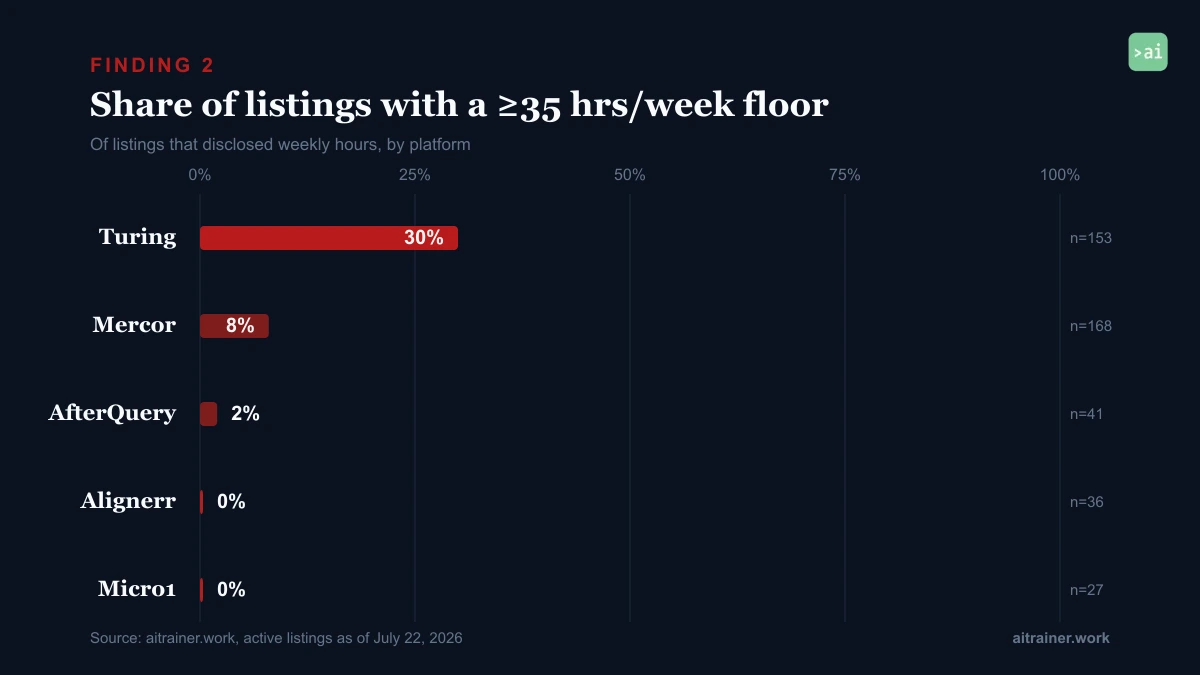
| Platform | % full-commitment (≥35 hrs/week floor) | Sample size (n) |
|---|---|---|
| Turing | 24.5% | 49 |
| AfterQuery | 4.5% | 22 |
| Mercor | 3.3% | 460 |
| Micro1 | 0% | 21 |
In practice this means Mercor, AfterQuery, and Micro1 are, by disclosed hours, overwhelmingly part-time or flexible-hours marketplaces, while Turing remains the only platform in the sample where a genuine near-full-time floor shows up in a meaningful share of listings, and even there it's a minority (24.5%) rather than a majority. SME Careers (n=1) and Alignerr (n=5, and its entire active pool is only 5 listings) don't clear the n≥10 bar for weekly-hours disclosure in the current sample.
A note on how this metric has moved over time. An earlier pass at this analysis used "ceiling ≥40 hrs/week" as the full-commitment test and reported Alignerr at 94%, driven almost entirely by boilerplate "10–40 hrs/week, flexible" phrasing where the number 40 was the top of a wide range, not a real commitment level; once the test required a floor near 40 rather than a ceiling that merely touched it, that figure corrected to 0% in the July refresh (see Limitations). Alignerr's active pool has since shrunk from 45 listings to 5, so it can no longer support a reliable reading under either definition. Mercor's qualifying listings have historically tended to state a single fixed number ("40 hours per week," "35 hours/week") rather than a wide range, which is part of why its full-commitment rate, though it has fallen from 8% to 3.3% as its total disclosed pool grew, has stayed a small single-digit share under both the old and current methodology rather than swinging the way Alignerr's did.
A caveat this finding still needs: this measures what platforms wrote in listing prose, not verified hours worked. A plausible alternative explanation is a difference in listing convention rather than a difference in actual work structure: Turing's listings read like traditional staff-augmentation postings, where stating a specific weekly-hours floor is standard boilerplate, while Mercor's and Micro1's listings more often read like task-based or flexible-engagement postings, where a genuine floor is often left unstated (or stated as a wide range) even when the underlying work is substantial for some workers. The gap could reflect real differences in how work is structured on each platform, differences in what each platform's template asks writers to disclose, or both. This dataset can't distinguish the two, and neither interpretation should be treated as settled by these numbers alone. Separately, Micro1's 0% figure should not be read as "Micro1 has no full-time roles": its disclosed sample is small (21 of 461 listings, 4.6%); it reflects what the platform's listings state about hours, not a verified count of full-time headcount.
Finding 3: Contract Duration by Domain
Contract duration is still better explained by domain than by platform alone, and this refresh surfaces a sharper version of that pattern than the July data did: it now shows up within a single platform, not just between platforms. On Mercor, mean contract length ranges from 3.0 weeks for Business (n=31) to 23.5 weeks for Languages (n=64), close to an 8x spread on one platform. On Turing, Business averages 14.8 weeks (n=10) against 10.2 weeks for Software Engineering (n=24), Turing's largest qualifying category. Mercor's Voice Acting cell, the July dataset's headline outlier at a 26-week mean (n=26), no longer clears the n≥10 disclosure threshold (current n=4) and can't be reported this round. AfterQuery and Alignerr have no domain cell clearing n≥10 in the current sample.
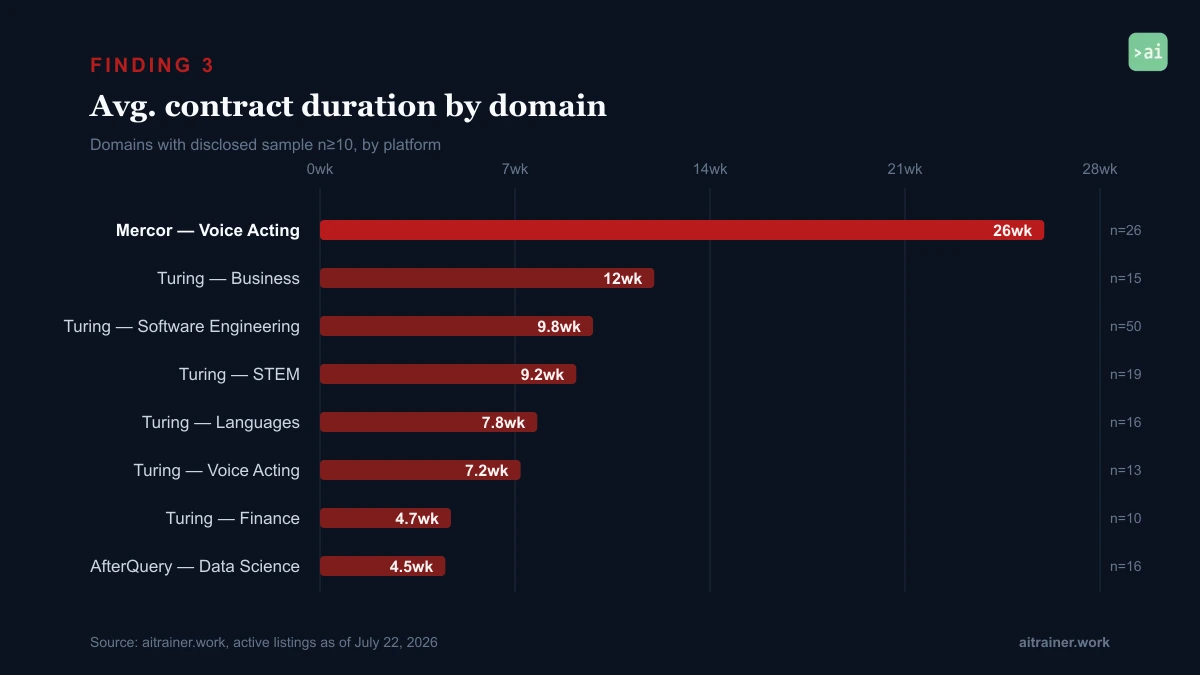
| Platform | Domain | Avg. contract length | Sample size (n) |
|---|---|---|---|
| Mercor | Languages | 23.5 weeks | 64 |
| Turing | Business | 14.8 weeks | 10 |
| Turing | Software Engineering | 10.2 weeks | 24 |
| Mercor | Generalist | 6.8 weeks | 10 |
| Mercor | Data Science | 3.6 weeks | 16 |
| Mercor | Business | 3.0 weeks | 31 |
Finding 4: Disclosure Rates as a Signal
The missing-data pattern is itself a finding, not just a methodological caveat. Interview process fails to clear the disclosure threshold on AfterQuery and Alignerr; weekly-hours commitment fails to clear it on SME Careers and Alignerr; contract duration clears it on only a minority of domains, and only on two platforms at all. Mercor and Turing are now the only two platforms in the sample whose active listings clear the n≥10 disclosure bar on all three coded fields, Mercor for the first time in this refresh (it fell short on interview requirement and, less severely, on contract-duration domain coverage in the original July snapshot). Whether that reflects a deliberate transparency practice or simply more verbose listing templates, the practical effect for a candidate is the same: Mercor and Turing listings currently give a reader more machine-codable information to evaluate before applying than the other four platforms in this sample.
| Platform | Interview requirement | Weekly hours | Contract duration |
|---|---|---|---|
| Turing | ✓ cleared n≥10 | ✓ cleared n≥10 | ✓ cleared n≥10 |
| Mercor | ✓ cleared n≥10 | ✓ cleared n≥10 | ✓ cleared n≥10 |
| Micro1 | ✓ cleared n≥10 | ✓ cleared n≥10 | ✕ below n≥10 |
| SME Careers | ✓ cleared n≥10 | ✕ below n≥10 | ✕ below n≥10 |
| AfterQuery | ✕ below n≥10 | ✓ cleared n≥10 | ✕ below n≥10 |
| Alignerr | ✕ below n≥10 | ✕ below n≥10 | ✕ below n≥10 |
✓ = disclosed sample cleared the n≥10 threshold for that field in this dataset; ✕ = below threshold, reported as insufficient sample rather than a percentage.
Limitations
This is a cross-sectional snapshot of active listings on a single date (September 8, 2026, refreshed from an original July 22, 2026 pull), not a longitudinal study; platforms' practices may shift as listings rotate, and this refresh itself is evidence of how much they can shift in seven weeks. The coding relies on pattern-based parsing of prose that was not written for machine readability, so per-listing miscoding is possible despite the source-sentence traceability check. The n≥10 disclosure threshold and manual spot-check were both applied specifically to bound that risk before publication, not eliminate it.
Three further limitations apply specifically to the percentages in Findings 1 and 2. First, this measures what a listing's prose states, not verified real-world practice; a platform's disclosed rate can move for reasons unrelated to actual hiring behavior, including changes to a listing template's wording. A platform's own structural "Full-time" tag, cross-checked against prose in the original July analysis, is no longer present in our current data pipeline and could not be re-checked in this refresh (see the Methodology note above). Second, the weekly-hours field itself required a definitional correction during the original analysis: an initial pass counted any listing whose stated range touched a ceiling of 40 hrs/week as "full-commitment," which produced a misleading 94% figure for Alignerr driven almost entirely by one repeated "10–40 hrs/week, flexible" phrasing pattern (see Finding 2). The published figures have required a disclosed floor of ≥35 hrs/week ever since; we flag this because the same class of error, treating a wide range's ceiling as a commitment signal, could in principle recur in future analysis passes on this or other fields. Third, disclosed-sample percentages describe only the subset of listings that stated the fact in prose, and that subset is a minority of each platform's total active listings for interview requirement (SME Careers 38.3%, Turing 30.5%, Micro1 6.9%, Mercor 10.6%, of total active listings) and, for weekly hours, ranges from a minority on some platforms to a majority on others (Alignerr 100% but n=5, Turing 59.8%, Mercor 36.0%, AfterQuery 10.8%, Micro1 4.6%, SME Careers 0.4%, of total active listings). If the decision to disclose a fact correlates with the type of role (for instance, higher-touch enterprise roles being described in more detail than high-volume task-based postings), the disclosed subset is not representative of the platform's full active listing set, and the reported percentage describes that subset, not the platform as a whole. Sample sizes also differ substantially by platform (Mercor n=1,277 vs. Alignerr n=5). Findings describe listing text as published, not verified outcomes for candidates who apply.
Conclusion
Six platforms competing for the same nominal pool of AI training talent show measurably different practices once compared on a common set of coded fields rather than read one careers page at a time. Interview requirements have converged since our original July pass: SME Careers, Micro1, Turing, and (newly, on a larger disclosed sample) Mercor all now gate essentially every disclosed listing behind an interview. On weekly hours, no platform in this sample is majority full-commitment once "full-commitment" requires a genuine floor near 40 hrs/week rather than just a range whose ceiling touches it: Turing leads at 24.5%, and Mercor, AfterQuery, and Micro1 all disclose single-digit or 0% full-commitment rates. Contract duration varies more by domain than by platform, with close to an 8x spread even within Mercor, the single best-sampled platform, once broken out by domain. A candidate comparing "AI training jobs" across these six sites today is, on several measurable dimensions, comparing structurally different labor arrangements that happen to share a category label, and reading the actual hours language in a listing, not just a number that happens to be 40, is the difference between an accurate and a misleading picture of the commitment involved.
Sources
- aitrainer.work proprietary listing-facts intelligence, active listings as of September 8, 2026 (originally published from a July 22, 2026 pull): Mercor (1,277 listings analyzed), Micro1 (461), SME Careers (253), Turing (82), AfterQuery (204), Alignerr (5).
- Per-field sample sizes (n) reported inline throughout this piece reflect only listings whose description text disclosed that specific fact; platforms/fields below n=10 are reported as "insufficient sample" rather than a percentage.
Related reading
Best AI training platforms compared: full reviews of every platform in this analysis.
Turing job listings: see the underlying active roles behind Turing's numbers above.
Mercor job listings: see the underlying active roles behind Mercor's numbers above.
Cite this page
"The AI Training Labor Market (2026): A Cross-Platform Analysis of 2,282 Job Listings", aitrainer.work, aitrainer.work/research/ai-training-job-listings-industry-analysis-2026

MSc Human-Computer Interaction | Founder
Pietro is the founder and technical lead of aitrainer.work. He builds and maintains the platform's data pipeline, certification infrastructure, and editorial standards.