
Pay Rates in the AI Evaluation Economy (2026): A Cross-Platform Benchmark of 2,082 Active Listings
We analyzed 2,082 active job listings across 7 AI evaluation platforms to benchmark hourly pay rates across platform tiers, role tracks, and pay distribution spreads.
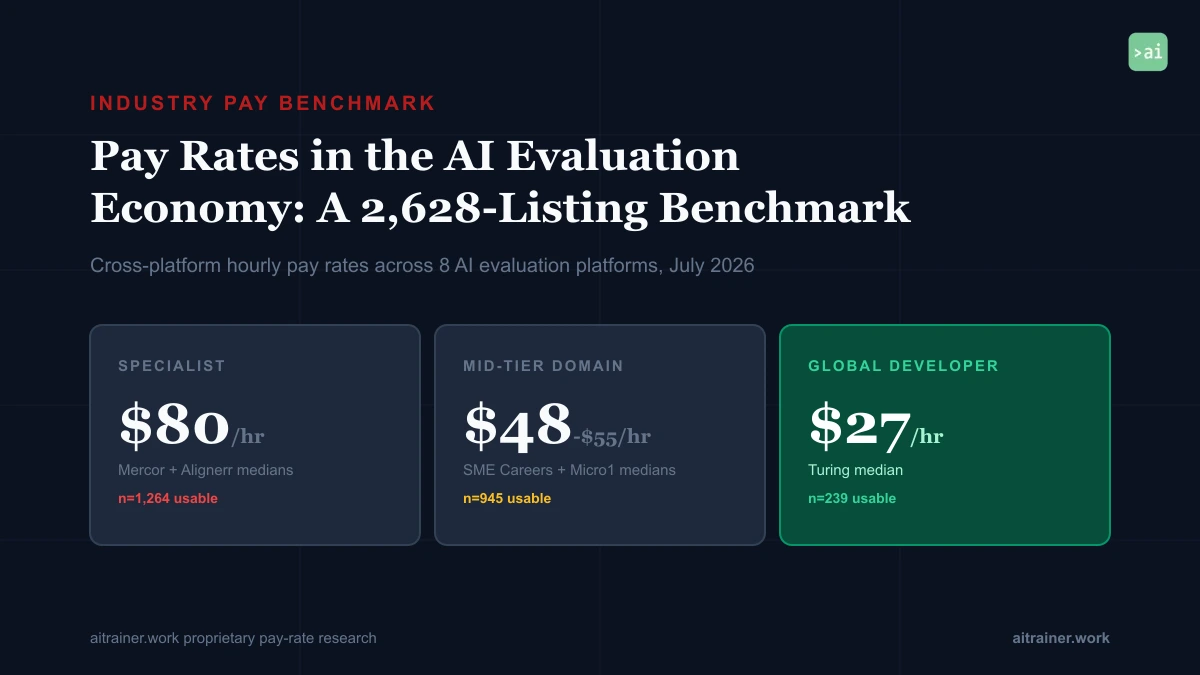
Abstract. We conducted a quantitative pay-rate study across 2,082 active job listings on AI evaluation platforms, normalizing disclosed pay rates to USD per hour. Across 1,907 usable rate observations clearing baseline filters, median hourly rates split into two tiers: a high-end specialist platform, Mercor ($77.50/hr median), and a mid-tier band now led by Micro1 ($60.00/hr median) ahead of SME Careers ($45.00/hr median). Turing publishes no pay rates, so it is not ranked; the figures on its listings are our own estimates. Alignerr's active pool has shrunk to 5 listings, below our $n \ge 10$ reliability threshold, so it can no longer support a platform-level median here even though its per-listing rates remain high. We report median, mean, interquartile range (P25–P75), and min/max pay benchmarks alongside explicit sample sizes ($n \ge 10$).
Key takeaways for job seekers & candidates
- Specialist Track Pay Premium: Mercor ($77.50/hr median, n=1,244) commands the top rate in the evaluation market, heavily driven by expert roles in specialized law, medicine, and software architecture.
- Mid-tier ranking has flipped since our July analysis: Micro1 ($60.00/hr median) now sits above SME Careers ($45.00/hr median); in the earlier snapshot SME Careers led that pair at $55.00 to Micro1's $48.50.
- Turing is not ranked: it does not publish pay rates. An earlier version of this report listed a $25.00/hr Turing median, which came from our own estimates, so we removed it.
- Alignerr can no longer be benchmarked reliably: its active pool fell from 34 listings in July to 5, below our reporting threshold, even though the listings that remain still post high rates.
Methodology
Scope & Exclusions. The dataset includes active job listings across primary employer platforms as of September 8, 2026 ($N = 2{,}082$ total listings; this is a full refresh of the original July 2026 pull, $N = 2{,}628$ then, using the same platform set). Non-employer re-post aggregators (Ethos) and task-based research sites (Terac) were excluded. Review platforms (Handshake, Mindrift, Outlier) were excluded from this active listings pool as they do not feed live listing data directly. Platforms lacking structured pay data (such as AfterQuery) were excluded from rate tables.
Rate Normalization to USD/Hour. Stated pay ranges were normalized to USD/hr. For listings with ranges, the midpoint was calculated; zero-floor placeholders were treated as missing data to avoid skewing range midpoints. Non-hourly rates were converted using standard benchmark commitments (30 hrs/week). Non-USD listings were excluded to eliminate foreign exchange volatility. Only platforms meeting an active sample threshold of $n \ge 10$ are reported as primary findings. A small number of Mercor listings currently carry a mismatched rate-unit tag (stated as an annual or monthly figure despite reading as an hourly rate in the listing prose); those were excluded from the normalized aggregates below rather than converted literally, since a literal conversion would produce a nonsensical rate.
Estimated rates are excluded. Where a platform publishes no rate, we show our own estimate on its listings (see how we source pay). Turing publishes no rates at all, so its 82 listings count toward the census but not toward any median. A few Micro1 listings with no stated pay also carry our estimate (5 of 394 live listings on September 25). At that share they cannot move Micro1's median, and the next refresh will leave them out.
Note on Mercor's weight in the pool. Mercor accounts for nearly two-thirds of all usable observations ($n = 1{,}244$ of 1,907). Because Mercor mixes high-end domain-expert roles with a large volume of generalist task work, its scale means Mercor-specific pay dynamics have outsized influence on the overall market picture presented here; the tier breakdown below should be read platform-by-platform rather than as a single blended market rate.
Finding 1: Platform Pay Benchmarks
Pay rates across the AI training labor market exhibit significant structural variance depending on platform target candidates and sourcing models.
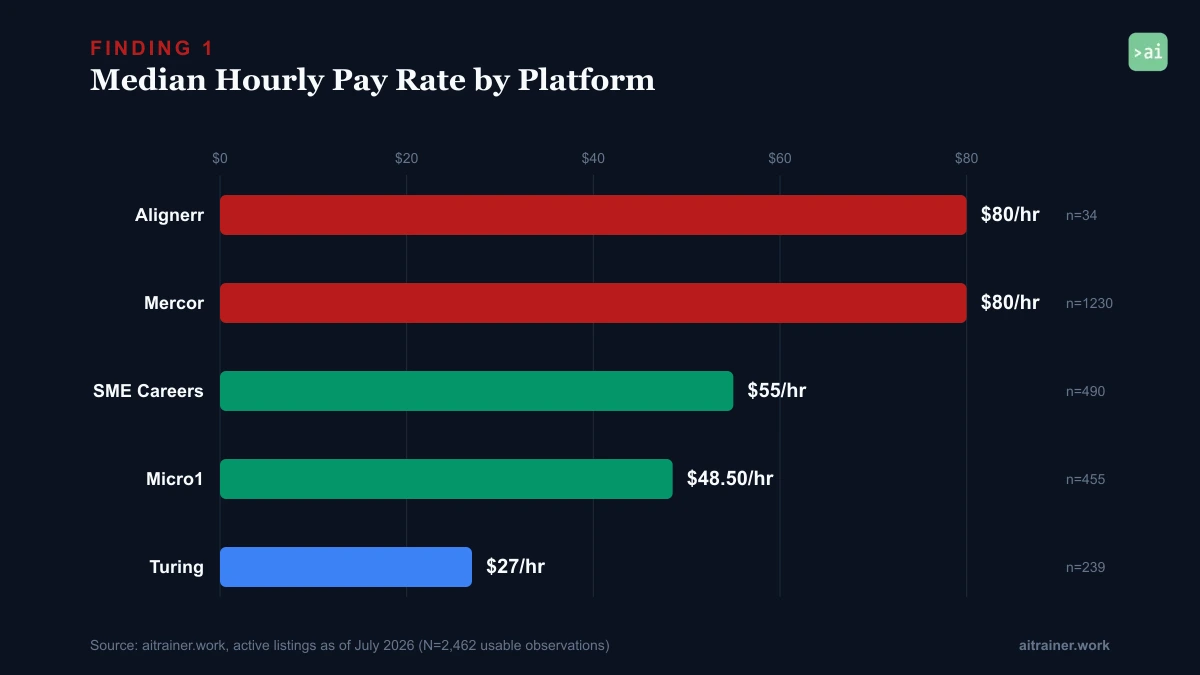
| Platform | Total Listings | Usable ($n$) | Median $/hr | Mean $/hr | P25 | P75 | Min | Max |
|---|---|---|---|---|---|---|---|---|
| Mercor | 1,277 | 1,244 | $77.50 | $80.80 | $50.00 | $100.00 | $1.00* | $350.00 |
| Micro1 | 461 | 401 | $60.00 | $71.95 | $40.00 | $90.00 | $6.00 | $270.00 |
| SME Careers† | 253 | 253 | $45.00 | $50.89 | $25.00 | $70.00 | $3.00* | $150.00 |
| Turing (no published rates) | 82 | 0 | Not published | |||||
| Alignerr (n<10) | 5 | 5 | $60.00 | $60.00 | $60.00 | $60.00 | $60.00 | $60.00 |
| Vetto (n<10) | 4 | 4 | $45.00 | $75.00 | $40.00 | $80.00 | $40.00 | $170.00 |
Rates normalized to USD/hour. Active listings census as of September 8, 2026 (originally July 2026). Alignerr's active pool has fallen to 5 listings since July (was 34) and Rex has no active listings at all (was $n=8$ for reference in July, now zero); both fall below the $n \ge 10$ threshold for generalized conclusions, alongside Vetto ($n=4$). Turing's listings state no pay; the rates we display on them are our estimates and are excluded here. *Mercor's $1.00 and SME Careers' $3.00 minimums are outlier listings (piece-rate or partially unparsed pay strings, including one literal internal test listing on Mercor) rather than representative floor offers; they are retained for transparency but should not be read as typical entry pay. †SME Careers' rate-unit field is not currently populated in our data pipeline for any of its listings; figures here use its stated pay amount treated as USD/hour, consistent with how its listings have always read, but this is a workaround rather than a directly-tagged field.
Finding 2: Pay Dispersion and Rate Volatility
The interquartile range (P25 to P75) highlights distinct compensation structures across platforms:
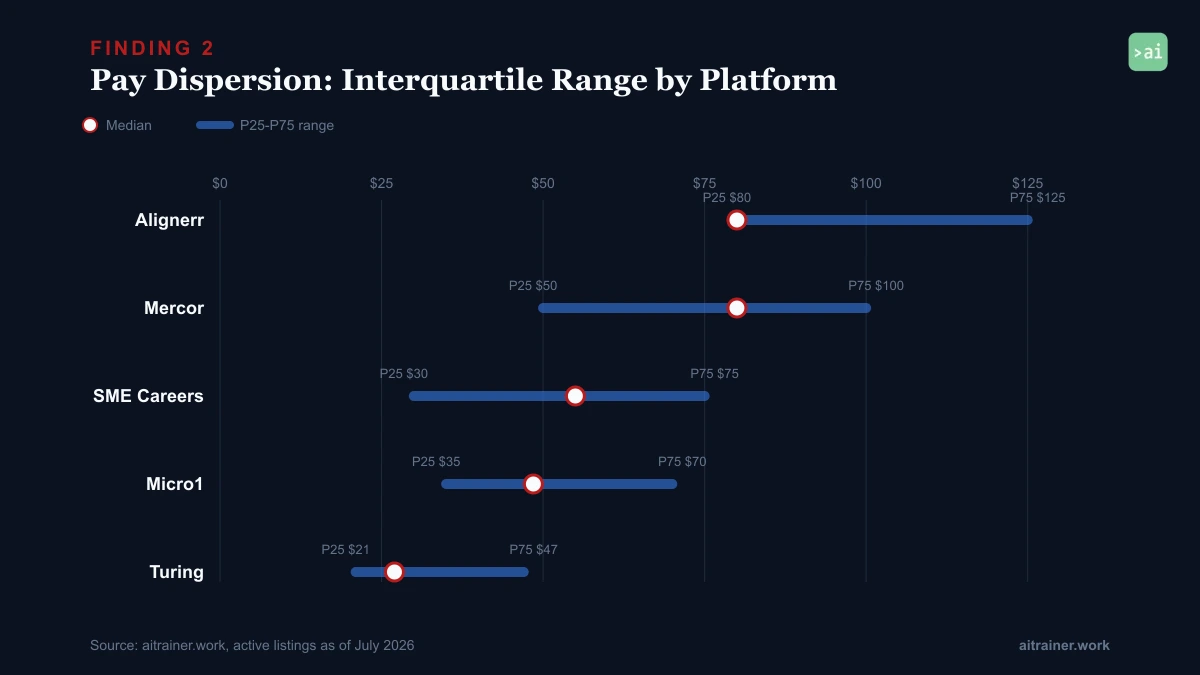
- Mercor: Features the widest rate spread ($50.00/hr to $100.00/hr IQR; maximum $350.00/hr), reflecting a market where generalist annotators start around $20–$30/hr while niche domain specialists (legal, medical, AI safety) command $100–$350/hr.
- Micro1: Now the second-highest-paying platform in the sample, with a $40.00–$90.00/hr IQR, up from a tighter $35.00–$70.00/hr band in July.
- SME Careers: Shows a lower band than in our July analysis ($25.00–$70.00/hr IQR, down from $30.00–$75.00/hr), and now sits below Micro1 rather than above it.
- Alignerr: No longer has enough active listings ($n=5$) to characterize a reliable spread; its July IQR ($80.00–$125.00/hr) reflected a much larger, now-shrunk pool.
Limitations
Advertised Rates vs. Realized Earnings. This analysis measures advertised hourly rates from public job postings. It does not account for unpaid onboarding, qualification tests, or platform commission fees.
Geographic Rate Variances. Listings offering geo-specific rates are aggregated as advertised; actual candidate offers may vary based on country location.
Advertised rates are not guaranteed offers. These platforms don't always pay what's advertised to every applicant. Top-of-range rates are typically reserved for candidates in Tier 1 countries (US, UK, Canada, etc.), and actual offers vary by location, experience level, qualifications, and role fit. Treat the figures in this report as the advertised ceiling and floor of the market, not a guarantee of what any individual candidate will be offered.
Realized vs. advertised pay. This report measures rates as advertised in open job postings, not audited payout data. We cannot verify what percentage of listings convert candidates at the advertised max, median, or min rate.
Conclusion
The AI evaluation market remains stratified, but the mid-tier ordering has shifted since our July analysis: Mercor leads at $77.50/hr median, and Micro1 has moved ahead of SME Careers ($60.00/hr vs. $45.00/hr, a reversal from July's $48.50/hr vs. $55.00/hr). Turing can't be placed on this scale because it publishes no rates. Alignerr, previously tied with Mercor at the top of the market, no longer has enough active listings to support a platform-level median at all, a reminder that these tiers describe a snapshot of the current active pool, not a fixed property of any platform.
Cite this page
"Pay Rates in the AI Evaluation Economy (2026): A Cross-Platform Benchmark of 2,082 Active Listings", aitrainer.work, aitrainer.work/research/ai-training-pay-rate-platform-analysis-2026

MSc Human-Computer Interaction | Founder
Pietro is the founder and technical lead of aitrainer.work. He builds and maintains the platform's data pipeline, certification infrastructure, and editorial standards.