
The End of Crowd-Work: How Domain Experts Are Restructuring the Economics of AI Post-Training
We coded 2,571 active AI evaluation listings across 9 platforms. Domain Expert Track roles pay a median of $75/hr, 1.5x the Generalist Track median of $50/hr. Legal and Finance roles reach $100+ medians.
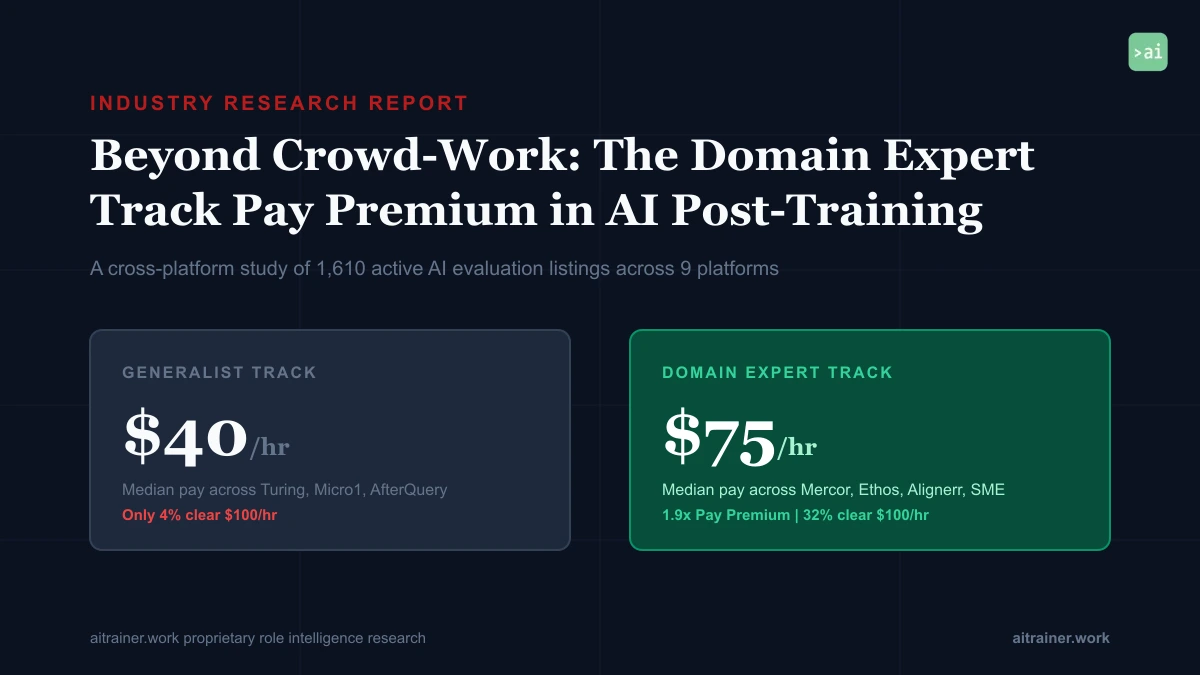
Abstract. Early AI data work was volume-driven: generalist contractors drew bounding boxes, tagged images, and verified simple classifications at scale. That model is dissolving. As frontier models approach ceiling performance on standard benchmarks, the bottleneck in AI development has shifted from data volume to evaluation quality, specifically the kind of normative professional judgment that generalist annotators cannot provide. We examined 2,571 active AI evaluation listings across nine platforms to measure how this structural shift is registering in posted compensation. We find a measurable pay separation between what we term the Generalist Track (high-volume, low-credential platforms: Micro1, AfterQuery, Mindrift) and the Expert Track (credentialed-specialist platforms: Mercor, SME Careers, Ethos, Alignerr): a median hourly rate of $75 vs. $50, a 1.5x premium, narrower than the 1.9x premium we measured in July. Turing publishes no pay rates, so its listings are left out of every track figure; an earlier version of this piece counted our estimates for it. Within Expert and Generalist listings combined, pay varies sharply by domain: Legal roles post a median of $105/hr, Finance $100/hr, and Healthcare $95/hr against Languages at $37.50/hr at the other end. The clean separation we reported in July, where every Expert Track platform posted a higher share of $100+/hr listings than every Generalist Track platform, no longer holds: Micro1, a Generalist Track platform, now posts a higher share of $100+/hr listings (16.4%) than two of the four Expert Track platforms. We report sample sizes with every finding, apply a $200/hr outlier screen to the platform-level figures, and note where domain-level samples fall below our n=10 reliability threshold.
Key takeaways
- 1.5x pay premium: Expert Track platforms post a median hourly rate of $75 vs. $50 on Generalist Track platforms, down from a 1.9x premium ($75 vs. $40) in our July analysis. Both figures exclude Turing, which publishes no rates.
- 16.0% of Expert Track listings clear $100/hr vs. 11.3% of Generalist Track listings, an ~1.4x gap, down sharply from July's 8x gap (32% vs. 4%). The gap has narrowed because one Generalist Track platform, Micro1, now posts more $100+/hr listings (16.4%) than two of the four Expert Track platforms.
- Domain still determines pay more than platform. Legal listings ($105/hr median) earn more than Software Engineering listings ($60/hr median), and that domain gradient is consistent across SME Careers and Mercor independently.
- Credential requirements are explicit and front-loaded on Expert platforms. SME Careers specifies a minimum degree on 83.4% of listings (40.3% Bachelor's, 32.0% Master's, 11.1% PhD). Mercor specifies a degree on 34.2% of listings.
- The extreme high end is no longer Mercor-exclusive: of the 35 active listings currently above $200/hr, 17 are on Mercor and 17 are on Micro1 (a Generalist Track platform), mostly BigLaw attorney and senior-specialist roles. In July, Mercor accounted for every listing above $200/hr.
A note on terms. Throughout this piece, "domain expert" and SME (subject matter expert) refer to the same role: a credentialed professional (physician, attorney, engineer, PhD researcher) hired not to label data but to exercise professional judgment on AI model output within their field. This is distinct from the older crowd-work model, where a generalist rater without domain credentials could complete the task. The SME is the labor category this piece is about; the Expert Track / Generalist Track split below is our attempt to measure where and how much that category is being paid for.
Methodology
Population and sampling frame. The dataset comprises all listings marked active in our curated role intelligence system as of September 8, 2026 (a full refresh of the original July 23, 2026 pull, N=1,610 then). Coverage: Mercor (n=1,277), Micro1 (n=461), Turing (n=82), SME Careers (n=253), Ethos (n=274), Alignerr (n=5), AfterQuery (n=204), Terac (n=11), and smaller platforms (Vetto: n=4; Rex has no active listings in the current pull); total N=2,571. Every platform's active pool has shifted since July, most sharply Mercor (182 → 1,277) and Alignerr (34 → 5). All listings were denominated in USD at the time of collection; non-USD rates were normalized to USD using static exchange rates applied at data-collection time.
Track classification. We classify platforms into two tracks based on their structural orientation: the Generalist Track (Micro1, AfterQuery, Mindrift) and the Expert Track (Mercor, SME Careers, Ethos, Alignerr). Turing would sit on the Generalist Track, but it publishes no pay rates: the figures on its listings are our own estimates (see how we source pay), so its 82 listings count toward N but not toward any track or platform pay figure. Expert Track platforms systematically require credentials as application prerequisites, gate listings through multi-stage vetting (AI interview, domain test, recruiter screen), and post rates denominated in hours rather than tasks. Generalist Track platforms accept applications without prior credential verification and primarily post task-based or flexible-hours roles accessible to any English speaker. We do not treat this as a quality claim; it is a structural descriptor.
Pay data and outlier handling. Pay figures are aggregated from each listing's structured data fields (pay_amount, pay_min, pay_max, pay_rate_unit). We use pay_amount as the primary measure, which represents the midpoint of the stated range where one exists and the single stated figure where it does not. We exclude listings with pay_amount = 0 or where pay_rate_unit is not per_hour. For platform-level medians and averages, we apply a $200/hr outlier screen: listings above $200/hr are excluded from platform aggregates, flagged separately in Finding 4, and reported with their own sample sizes. Two data-pipeline issues specific to this September refresh: SME Careers' pay_rate_unit field is currently unpopulated for all of its listings even though pay_amount is present and reads as an hourly figure; we treat it as per_hour for this piece rather than excluding the platform entirely, and flag it wherever it's used. Separately, a handful of Mercor listings carry a mismatched rate-unit tag (annual or monthly despite hourly-looking prose); those are excluded from aggregates rather than converted literally.
Missing-data handling and reporting threshold. We report domain-level medians only where n≥10 listings in that domain-platform cell disclose a non-zero hourly rate. Below that threshold we describe the cell as insufficient sample. All percentages in this piece are accompanied by their denominator (n) in the text itself, not only in a footnote.
Finding 1: The Expert Track Pay Premium
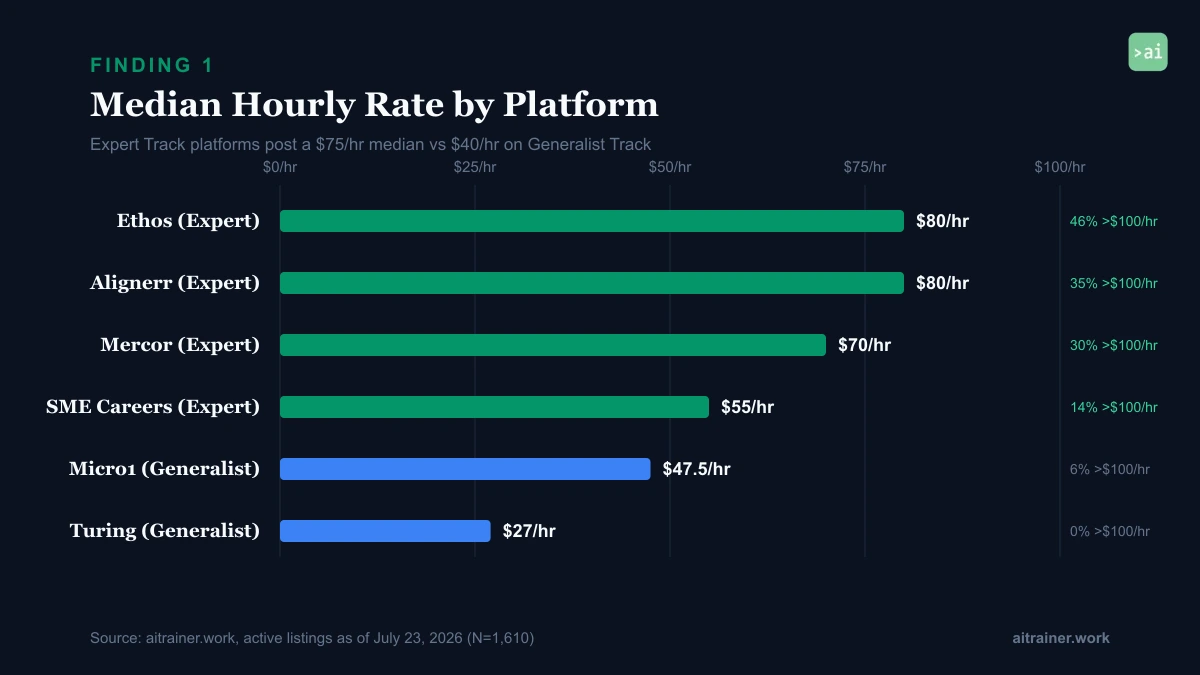
The most direct quantification of the structural shift in AI evaluation economics is the gap between what Expert Track platforms post and what Generalist Track platforms post. Across 2,314 listings with disclosed hourly rates, Expert Track listings (n=1,758) show a median of $75/hr and Generalist Track listings (n=556) a median of $50/hr, a 1.5x premium, down from the 1.9x premium ($75 vs. $40) we measured in July.
| Track | Platforms | N (with pay) | Median/hr | Maximum/hr |
|---|---|---|---|---|
| Expert Track | Mercor, SME Careers, Ethos, Alignerr | 1,758 | $75 | $350 |
| Generalist Track | Micro1, AfterQuery, Mindrift | 556 | $50 | $270 |
The high-pay threshold ($100/hr) still shows a gap, but a much narrower one than we reported in July. 16.0% of Expert Track listings (282/1,758) clear $100/hr versus 11.3% of Generalist Track listings (63/556), an ~1.4x difference, down from the 8x gap (32% vs. 4%) in the original analysis. Unlike in July, this is no longer true uniformly across every platform pair: Micro1, a Generalist Track platform, now posts $100+/hr listings at a higher rate (16.4%, 63/384) than two of the four Expert Track platforms, SME Careers (6.7%) and Ethos (2.2%). The narrative that every Expert Track platform beats every Generalist Track platform on this measure, which held in the July data, does not hold in the current dataset.
| Platform | Track | N | Median/hr | Avg/hr | % above $100/hr | Max/hr |
|---|---|---|---|---|---|---|
| Mercor | Expert | 1,227 | $75 | $78.36 | 21.1% | $350 |
| Ethos | Expert | 273 | $80 | $82.64 | 2.2% | $225 |
| Micro1 | Generalist | 384 | $55 | $63.42 | 16.4% | $270 |
| SME Careers† | Expert | 253 | $45 | $50.89 | 6.7% | $150 |
| Mindrift | Generalist | 172 | $50 | $47.32 | 0.0% | $90 |
| Turing (no published rates) | Generalist | 0 | Not published | |||
| Alignerr (n<10) | Expert | 5 | $60 | $60 | 0.0% | $60 |
| AfterQuery | Generalist | 0* | N/A | N/A | N/A | N/A |
*AfterQuery listings do not disclose hourly rates in a machine-readable field; the platform uses task-based and project-based compensation. Its 204 listings are included in the active listing count but excluded from hourly pay analysis. †SME Careers figures use its stated pay amount as USD/hour; its rate-unit field is not currently populated (see Methodology). Alignerr's active pool has shrunk to 5 listings and no longer clears our n≥10 reliability threshold; it's shown for reference, not as a primary finding. Turing's 82 listings state no pay; the rates we display on them are our estimates, so they are excluded.
SME Careers sits at a lower median ($45/hr) than the other Expert Track platforms despite being credentialed-specialist-only by design, a pattern that held in July too, though the gap has widened as SME Careers' median fell from $55/hr. The reason is compositional: SME Careers' largest listing category by volume is quality assurance leads and language specialists (see Finding 2), which pull the platform median down even though its specialist medical, legal, and engineering roles are competitive with Mercor. Platform medians are a summary of whatever the platform happens to be hiring for at a given point in time, not a fixed property of the platform. Domain-level comparison is more informative.
Finding 2: The Domain Gradient
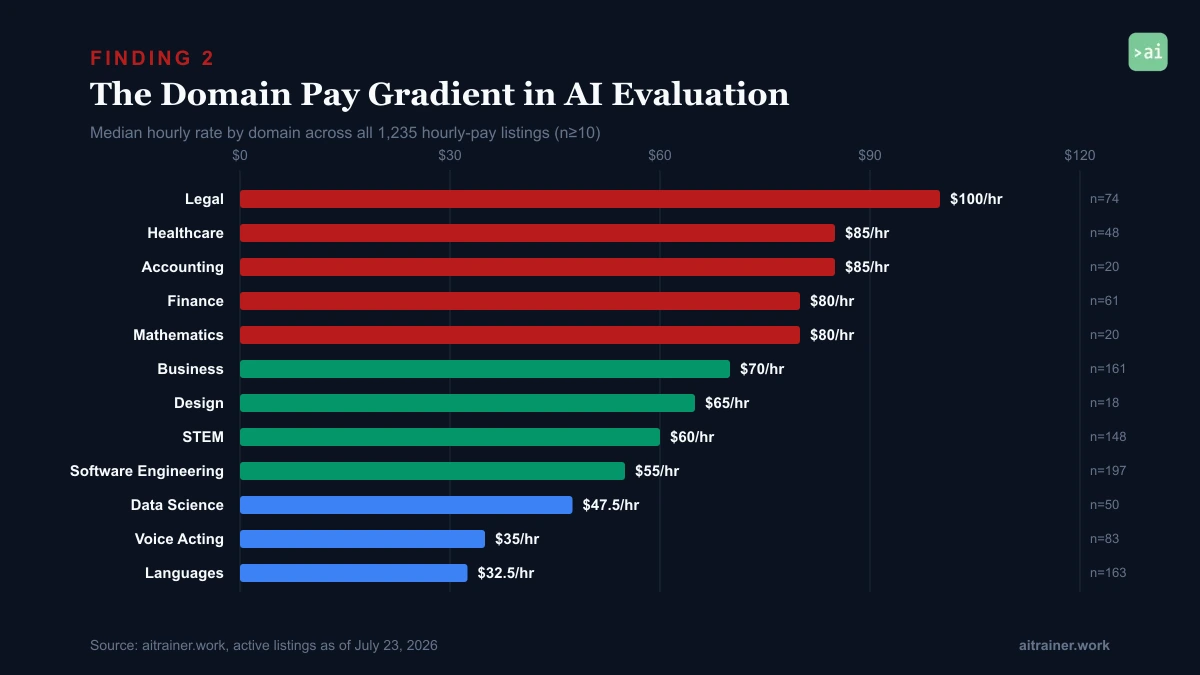
Pay varies more by domain than by platform. When we aggregate all 2,396 hourly-pay listings (both tracks, $200/hr-screened) by domain category and apply the n≥10 threshold, a clear gradient emerges: Legal listings ($105/hr median, n=140) are the highest-compensated domain in the full dataset, followed by Finance ($100/hr, n=64), Healthcare ($95/hr, n=119), and Accounting ($85/hr, n=39). At the other end, Languages ($37.50/hr, n=365) posts the lowest median of any domain clearing our threshold, and with QA Testing ($40/hr) and Psychology ($47.50/hr) it sits below the current Generalist Track median ($50/hr). Voice Acting, which posted below the Generalist Track median in July ($35/hr then), has moved to $60/hr, now above it.
| Domain | N | Median/hr | Avg/hr |
|---|---|---|---|
| Legal | 140 | $105 | $100.10 |
| Finance | 64 | $100 | $101.08 |
| Healthcare | 119 | $95 | $101.06 |
| Accounting | 39 | $85 | $87.53 |
| Business | 345 | $80 | $82.19 |
| Humanities | 39 | $75 | $76.95 |
| Mathematics | 31 | $75 | $74.90 |
| Generalist | 401 | $70 | $66.31 |
| STEM | 274 | $70 | $72.50 |
| Data Science | 48 | $70 | $69.54 |
| Design | 36 | $70 | $70.00 |
| Software Engineering | 278 | $60 | $66.15 |
| Voice Acting | 40 | $60 | $62.40 |
| Writing | 69 | $55 | $57.54 |
| Psychology | 18 | $47.50 | $60.17 |
| QA Testing | 79 | $40 | $46.53 |
| Languages | 365 | $37.50 | $40.04 |
Creative (n=7) and IT & Systems (n=4) fall below our n≥10 threshold and are omitted from this table; all rows shown cleared n≥10. This table still includes Turing's 82 listings, whose rates are our estimates. Rechecking without them leaves most domains unchanged; the two that move are Software Engineering (31 Turing listings, median about $5 higher without them) and Voice Acting (6 listings, about $15 higher).
The domain gradient holds when we isolate individual platforms, though the specific figures have moved. On SME Careers, Legal roles post a median of $110/hr (n=7, below our n≥10 floor, shown for reference) and Healthcare roles $90/hr (n=10) against the platform overall median of $45/hr. On Mercor, Legal roles post $100/hr (n=103), Healthcare $101.25/hr (n=84), and Software Engineering $80/hr (n=86), all comfortably clearing n≥10 now, against the platform median of $75/hr. In both cases, the platform-level median is a weighted average of a heterogeneous mix: a low-paying language-specialist listing exists on the same platform as a $200+/hr legal or healthcare listing (see Finding 4).
The practical implication is that a professional choosing between platforms should be comparing at the domain level, not the platform level. A physician evaluating AI medical content is comparing Ethos, Mercor, and SME Careers' Healthcare cells; all in the $90-$101/hr range, not platform averages. A software engineer is comparing Software Engineering cells across the same platforms: $62.50-$80/hr on SME Careers and Mercor, depending on seniority signals in the listing.
Finding 3: Credential Density on Expert Platforms
The pay premium on Expert Track platforms is structurally associated with explicit credential requirements. SME Careers is the most explicit about this in the dataset: 83.4% of its listings (211/253) specify a minimum degree requirement: 40.3% (102) require a Bachelor's, 32.0% (81) a Master's, and 11.1% (28) a PhD. 16.6% (42) leave the credential field unspecified.
| Platform | Bachelor's | Master's | PhD | Not specified | Any degree required |
|---|---|---|---|---|---|
| SME Careers | 40.3% (102) | 32.0% (81) | 11.1% (28) | 16.6% (42) | 83.4% |
| Mercor | 15.7% (200) | 7.0% (90) | 11.4% (146) | 65.8% (840) | 34.2% |
| Ethos | N/A | N/A | N/A | 100% | 0%* |
*Ethos does not surface a structured degree field in its listing data; credential requirements are embedded in prose descriptions and were not parsed for this analysis. Ethos's vetting is known to include active professional licensure checks at the application stage, which is a functional equivalent not captured in this table.
Mercor's lower declared-credential rate (34.2%, down slightly from 40% in July) reflects a different verification architecture: many Mercor listings foreground professional experience and peer-reviewed publication records (e.g., "ML Research PhD Experts (ICML / NeurIPS / ICLR Publications)") in prose without populating the structured degree field. The 65.8% "not specified" on Mercor does not indicate the absence of credential requirements; it indicates that Mercor routes verification through the interview and vetting process rather than through the listing form.
The degree requirement on SME Careers correlates with pay at the job-family level. Listings requiring a PhD have a median pay of $75/hr (n=28), those requiring a Master's $40/hr (n=81), and those requiring a Bachelor's $50/hr (n=102). The seemingly counterintuitive PhD-vs-Master's pattern reflects job mix rather than a negative return to a doctorate: the PhD pool is concentrated in STEM specialist roles (astronomer, biomedical engineer, data scientist team lead), while the Master's pool is heavily weighted toward language-specialist and QA-lead roles that carry lower base rates regardless of credential, the same pattern we found in the July analysis.
Finding 4: Where the $100/hr Ceiling Breaks
The $200/hr outlier screen applied to platform aggregates in Finding 1 excludes a small but real set of listings that represent the upper bound of what the AI evaluation market currently posts. We report them separately because they are substantively informative about where the structural ceiling is, and this round they overturn what we reported in July. Across the full 2,571-listing dataset, 35 listings currently post above $200/hr, split almost evenly between Mercor (17) and Micro1 (17), with 1 on Ethos. In July, Mercor accounted for every listing above $200/hr; that is no longer the case. Micro1 is classified as a Generalist Track platform in this piece precisely because it doesn't gate applications on credentials the way Mercor, SME Careers, Ethos, and Alignerr do, yet its current top-end listings, largely BigLaw attorney roles, sit at exactly the price point the Expert Track thesis says should require that gate.
| Listing title | Platform | Hourly rate | Domain |
|---|---|---|---|
| Radiology — Visual Document Understanding | Mercor | $350 | Writing |
| Agent Engineer | Mercor | $300 | STEM |
| UK-Based Restaurant and Hospitality Technology Experts | Mercor | $300 | Business |
| CUDA Engineering Expert | Mercor | $300 | STEM |
| Excel/PowerPoint/Document Style Experts | Mercor | $300 | Generalist |
| BigLaw Lawyers (Litigation/Corporate/M&A) | Micro1 | $270 | Legal |
| Litigation Associate Attorney (BigLaw Firms) | Micro1 | $270 | Legal |
| Mergers & Acquisitions (M&A) Attorney (BigLaw Firms) | Micro1 | $270 | Finance |
| Corporate Attorney (BigLaw Firms) | Micro1 | $270 | Legal |
| Family Law Attorney (AAML Registered) | Micro1 | $270 | Legal |
| Immigration Attorney | Micro1 | $270 | Legal |
| Healthcare Attorney (BigLaw Firms) | Micro1 | $270 | Legal |
| Civil Rights Attorney (BigLaw Firms) | Micro1 | $270 | Legal |
| Criminal Lawyer (BigLaw Firms) | Micro1 | $270 | Legal |
| Criminal Defense Attorney (BigLaw Firms) | Micro1 | $270 | Legal |
| PhD & Academic Expert | Micro1 | $262.50 | STEM |
| Senior Journalist / Writer | Micro1 | $262.50 | Writing |
| Investment & Finance Expert | Micro1 | $262.50 | Business |
| Data Scientist | Micro1 | $262.50 | Data Science |
| Management Consultant | Micro1 | $262.50 | Business |
| Accounting & Audit Expert | Mercor | $250.50 | Accounting |
| Film and Video Editors | Mercor | $250.50 | Data Science |
| Real Estate Sales Agents | Mercor | $250.50 | Data Science |
| Audio and Video Technicians | Mercor | $250.50 | Data Science |
| US-Based Business Owners Using Google Chat | Mercor | $250 | Generalist |
| Finance Expert — Public Equities Analyst / PM | Mercor | $240 | Business |
| US & UK-Based Labor & Employment Lawyers | Mercor | $237.50 | Legal |
| Doctor Medical Expert | Ethos | $225 | Healthcare |
| Cybersecurity Research Expert | Mercor | $225 | Software Engineering |
| UK-Based Legal Experts: Magic Circle | Mercor | $225 | Legal |
| Hebrew Professional Voice Actor | Mercor | $225 | Voice Acting |
| Healthcare Expert | Micro1 | $218.50 | Healthcare |
| Cross-Border Financial Services Expert (Brazil ↔ USA) | Mercor | $210 | Finance |
| Finance Expert — Trading, Derivatives & Crypto | Mercor | $207.50 | Business |
Three observations, revised from what we reported in July. First, the extreme project-rate tier we previously reported here, several Mercor listings priced at $1,000+/hr, appears to have rotated out of the active pool entirely: nothing in the current dataset prices above $350/hr, and that ceiling is a hospital-radiology documentation role, not a headline "expert network" listing. We can't tell from this snapshot alone whether that tier moved to a different part of Mercor's platform, filled and closed, or was repriced; we simply don't observe it now. Second, and the more consequential shift: Micro1 now supplies exactly as many $200+/hr listings as Mercor (17 apiece), almost entirely a block of BigLaw attorney roles at a flat $270/hr and a set of "PhD & Academic Expert"-style postings at $262.50/hr. These read like credentialed, licensure-gated professional work in substance, even though Micro1 doesn't screen for credentials at the application stage the way this piece's Expert Track platforms do; the pay data alone can't confirm what Micro1's actual selection process for these specific roles looks like, only that its posted rate for them now matches Mercor's top end. Third, the $207.50-$237.50 range still represents genuine hourly evaluation work by actively licensed professionals (physicians, attorneys) on both Mercor and Ethos, consistent with the July finding and with the TNW-cited aitrainer.work finding that Ethos posts rates in the $105-$225/hr range for credentialed expert evaluators.
Discussion: What Is Being Purchased
The pay gap between tracks is not simply a market quirk, it reflects a structural shift in what AI labs are buying. Early RLHF data collection was designed around tasks where the correct answer was checkable by a naive rater: "does this image contain a cat," "rank these two responses by fluency." Human judgment served as a cheap, scalable approximation of ground truth on tasks with unambiguous answers.
The tasks that Expert Track platforms list have no such unambiguous ground truth. Whether a clinical diagnosis is sound, whether an employment contract contains an illegal restraint of trade clause, whether a biomedical engineering calculation meets regulatory standards. These are normative judgments that require not just information but the professional infrastructure that converts information into defensible conclusions. This is consistent with how RLHF alignment itself is understood: model behaviors like safety, tone, and helpfulness are trained against normative, context-dependent conventions rather than fixed factual answers, which is why judging them correctly requires a rater who holds the relevant professional or cultural context. A physician evaluating an AI-generated differential diagnosis is not "labeling data." They are providing the ground truth reference against which the model's output is measured, in a domain where that reference is only available from someone who has completed the professional formation required to issue it.
This distinction between verification (can a generalist check this?) and authority (does this require professional formation to evaluate?) maps directly onto the Taxonomy Framework's three-tier model of RLHF annotation: Extension (volume), Evidence (factual accuracy), and Authority (professional standards). The domain gradient in Finding 2 is a market price signal for that authority: Legal, Finance, and Healthcare posts clear $95-$105/hr because courts, hospitals, and regulatory bodies recognize the cost of forming a professional capable of exercising that authority, and AI labs are now paying to access it. Languages clears $37.50/hr because the authority required is different in kind and more broadly distributed. Finding 4 complicates a purely track-based version of this story, though: some of the highest-paying listings currently active are on a Generalist Track platform, which suggests the market is pricing the specific credential (a BigLaw attorney, a PhD academic) rather than track membership itself when a platform chooses to list that kind of role.
The economic consequence for professionals is that the decision to enter the AI evaluation market should be made at the domain level, not the "AI training" level. A nurse deciding whether to supplement income through AI evaluation work is not choosing between "AI training" and "nursing", they are assessing whether the Healthcare cell of the market (median $95/hr based on current active listings) is an appropriate use of their credential. A software engineer evaluating the same question should compare the Software Engineering cell ($62.50/hr median on SME Careers, $80/hr median on Mercor for the same domain) against their opportunity cost.
Limitations
Selection and sampling frame sensitivity. While the macro trend (credentialed platforms paying a structural premium over generalist crowd platforms) is still directionally present, it is no longer robust across every platform pair: this refresh's own Finding 1 shows Micro1, a Generalist Track platform, beating two of the four Expert Track platforms on the share of $100+/hr listings. Specific numerical medians (e.g., $75 vs. $50/hr) are sensitive to listing aggregation and categorization. Platforms carry vastly different job mixes: for instance, SME Careers' lower overall median ($45/hr) relative to Mercor ($75/hr) is heavily influenced by a large volume of language-support and QA-lead roles in its active catalog rather than lower pay for equivalent specialist positions.
Nominal posted rates vs. realized hourly earnings. This dataset measures advertised hourly rates on active postings, not verified post-payout earnings. In practice, effective hourly rates frequently lag posted rates once unpaid administrative overhead (unpaid onboarding, qualification tests, task queue wait times, and rejected work) is factored in. Furthermore, posted ranges often reflect tier 1 (US/UK) ceiling rates, whereas geographic rate adjustments routinely lower effective pay for workers based in other regions.
Task-chunk distortions in niche domains. Domain-level anomalies frequently reflect platform listing conventions rather than lower professional valuation. In specialized domains, platforms often post fractional task-chunk payouts, micro-screening assessments, or entry-level rater roles under broad academic category tags rather than full professional consulting contracts, artificially depressing the calculated hourly rate.
Cross-sectional data snapshot, and how much it can move. This study reflects active public listings as of September 8, 2026, refreshed from an original July 23, 2026 pull. The two snapshots taken seven weeks apart disagree on findings we originally reported as structural (which platform accounts for the market's $200+/hr ceiling; whether every Expert Track platform outpaces every Generalist Track platform on high-pay share), which is itself evidence that listing inventories rotate fast enough to change not just the numbers but the shape of a finding within a single quarter. The track classification (Expert vs. Generalist) describes platform structural characteristics and candidate entry gates, not worker quality, individual platform preference, or a guarantee that a platform's postings will always match its track's typical pay profile.
Conclusion
The structural separation between Expert Track and Generalist Track AI evaluation platforms is still measurable in posted compensation, though it is narrower and less uniform than we reported in July. A 1.5x median pay premium ($75 vs. $50/hr), a still-real but reduced ~1.4x difference in the share of listings above $100/hr (16.0% vs. 11.3%, down from an 8x gap), and a consistent domain gradient from $105/hr (Legal) to $37.50/hr (Languages) are all observable from the current snapshot of 2,571 active listings. The cross-platform consistency of the domain gradient, Legal outperforming Software Engineering outperforming Languages on both SME Careers and Mercor independently, still suggests the gradient reflects genuine market pricing of domain authority rather than an artifact of how any single platform sets its rates. But the track-level story has weakened: Finding 4's discovery that Micro1 now matches Mercor at the extreme high end complicates the claim that track membership alone predicts pay ceiling, even as the median-level premium and domain gradient both hold up.
What this means for the AI evaluation economy in practice: the transition from crowd-based annotation to domain-expert evaluation still looks like a structural fork at the median, but this round's data is a reminder that the fork is a description of typical practice, not a guarantee, and that a platform's classification as "Generalist Track" doesn't rule out an occasional listing priced like an Expert Track role. Generalist Track platforms still mostly serve a labor supply function for tasks that do not require professional authority. Expert Track platforms still mostly serve a knowledge-acquisition function for tasks where professional formation is the prerequisite to providing usable ground truth. The two tracks compete for the same headline category ("AI training jobs") and mostly purchase different things, but a professional evaluating a specific listing should still read that listing's own credential requirements and pay, not assume its outcome from the platform's track alone.
Sources
- aitrainer.work proprietary role intelligence, curated and aggregated from leading platforms, active listings as of September 8, 2026 (originally published from a July 23, 2026 pull, N=1,610 then): Mercor (1,277), Micro1 (461), Turing (82), SME Careers (253), Ethos (274), Alignerr (5), AfterQuery (204), Terac (11), other platforms (4); total N=2,571.
- Domain-level pay figures computed from listings that disclose a non-zero hourly rate and clear the $200/hr outlier screen (n=2,396 of 2,571 total). Per-domain n reported inline throughout. Cells below n=10 flagged as insufficient sample.
- Credential distribution data (min_degree field) aggregated from SME Careers (n=253) and Mercor (n=1,277) formatted listing files. Ethos degree field not populated in structured data; omitted from credential table.
- Track-level comparison excludes AfterQuery from hourly pay figures (0 listings with disclosed hourly rate in the dataset) and applies a $200/hr outlier screen to platform medians and averages. Outlier listings reported separately in Finding 4. SME Careers' rate-unit field is not currently populated in our pipeline; its pay_amount is treated as USD/hour throughout, flagged where used (see Methodology).
- Taxonomy Framework: The Taxonomy Framework: Three Models of RLHF Annotation: Extension, Evidence, and Authority (arXiv, April 2026). Referenced in the Discussion section as an external conceptual frame; this piece's empirical findings are independent of that framework.
- Toloka AI, Complete guide to RLHF for LLMs (Toloka AI, February 2026). Referenced in the Discussion section on the normative, context-dependent nature of RLHF alignment judgments.
- TNW citation: Ana-Maria Stanciuc, "Ethos lands $22.75m Series A to fix what AI broke about hiring," The Next Web, May 6, 2026. The cited aitrainer.work per-hour rate finding ($105-$225 for Ethos) is broadly consistent with the $80-$225/hr range observed for Ethos in this dataset (different listing cohort, different collection date).
Related reading
The AI Training Labor Market (2026): Cross-Platform Analysis of 2,282 Listings: our companion piece on interview requirements, weekly hours, and contract duration across the same platform set.
Best AI training platforms compared: full reviews of every platform in this analysis.
Mercor job listings: see active Expert Track roles behind the Mercor figures above.
SME Careers job listings: see active Expert Track roles behind the SME Careers figures above.
AI Training Pay Survey: self-report your own rates to contribute to the next wave of this analysis.
Cite this page
"The End of Crowd-Work: How Domain Experts Are Restructuring the Economics of AI Post-Training", aitrainer.work, aitrainer.work/research/beyond-crowd-work-domain-expert-pay-2026

MSc Human-Computer Interaction | Founder
Pietro is the founder and technical lead of aitrainer.work. He builds and maintains the platform's data pipeline, certification infrastructure, and editorial standards.