
My Micro1 (Zara) AI Interview Experience (2026)
I took Micro1's Zara AI interview for a UX Designer Specialist role. The written questions, the practice run, the five focus areas, the question I lost, and the certification that followed two days later.
On September 4th I applied for a UX Designer Specialist role on Micro1. Two written questions, a practice interview, and 28 minutes with an AI called Zara, all finished the same afternoon.
Almost everything written about Micro1's interview is about the coding version of it. Mine had no code editor in it anywhere. I'm a UX researcher, and the questions went straight at the things a researcher gets hired to do: justify a decision, pull a piece of work apart, hold a position in a disagreement.
I'm not going to quote the questions. The role is live and someone else is going to sit this interview next week. How it's built and what it feels like from the inside is the part I wanted to know beforehand anyway, so that's what this is. If you're heading for the engineering version, with the code editor and the proctoring, that's a different interview and we wrote it up in the Micro1 technical interview guide.
What happened
- Two written questions came first, before any interview was scheduled, and they turned out to be the same rubric I'd be scored on live.
- I got a full practice run in the real interface, about 15 minutes, and it's the reason nothing surprised me later.
- The real interview was 28 minutes, stated on screen before I started.
- Five focus areas ran along the top of the screen, roughly one question each, so I always knew where I was.
- Every question appeared as text as well as spoken, so I could read it back before answering.
- Camera and screen-share stayed on the whole time, for the practice run as well as the real one.
- I lost a question by thinking out loud. Zara took my thinking as my answer and moved on.
- Nothing asked for my career history, but my own projects were still the best material I had.
- The result came in two emails: next-day, my profile moved into Micro1's vetted talent pool for human review; a day after that, I was certified with Discord access and role matching starting.
Live Micro1 Roles
Showing the 6 latest open roles

Simulation Expert — Real-to-Sim 3D Environments & Assets
$60-150
/hr
Korean Language Expert
$70-100
/hr
Investment Banking Associate
$45-100
/hr
Bilingual Cantonese Psychiatrist
$100-200
/hr
Bilingual Vietnamese Psychiatrist
$100-200
/hr
The application started with two written questions
Before there was any talk of an interview, the application asked me to type out two answers. One wanted a professional decision I'd made: the trade-off in it, what I picked, and why. The other asked me to take something complicated from my field and explain it the way I would to a smart colleague who doesn't work in it.
I wrote them, submitted, and stopped thinking about them. Then the interview opened and two of the five focus areas across the top of the screen were Decision Rationale and Communication For Non-Specialist Audiences. The same two things, asked again out loud.
The written questions are a preview of the rubric. Had I clocked that at the time, I'd have kept my own two answers open in a tab and reused the thinking instead of building it again from scratch under a clock.
I nearly skipped the practice run
Micro1 offered a full practice interview in the same interface before the real one. I took it out of professional curiosity about how the thing was built, and it ended up being the most useful 15 minutes of the afternoon.
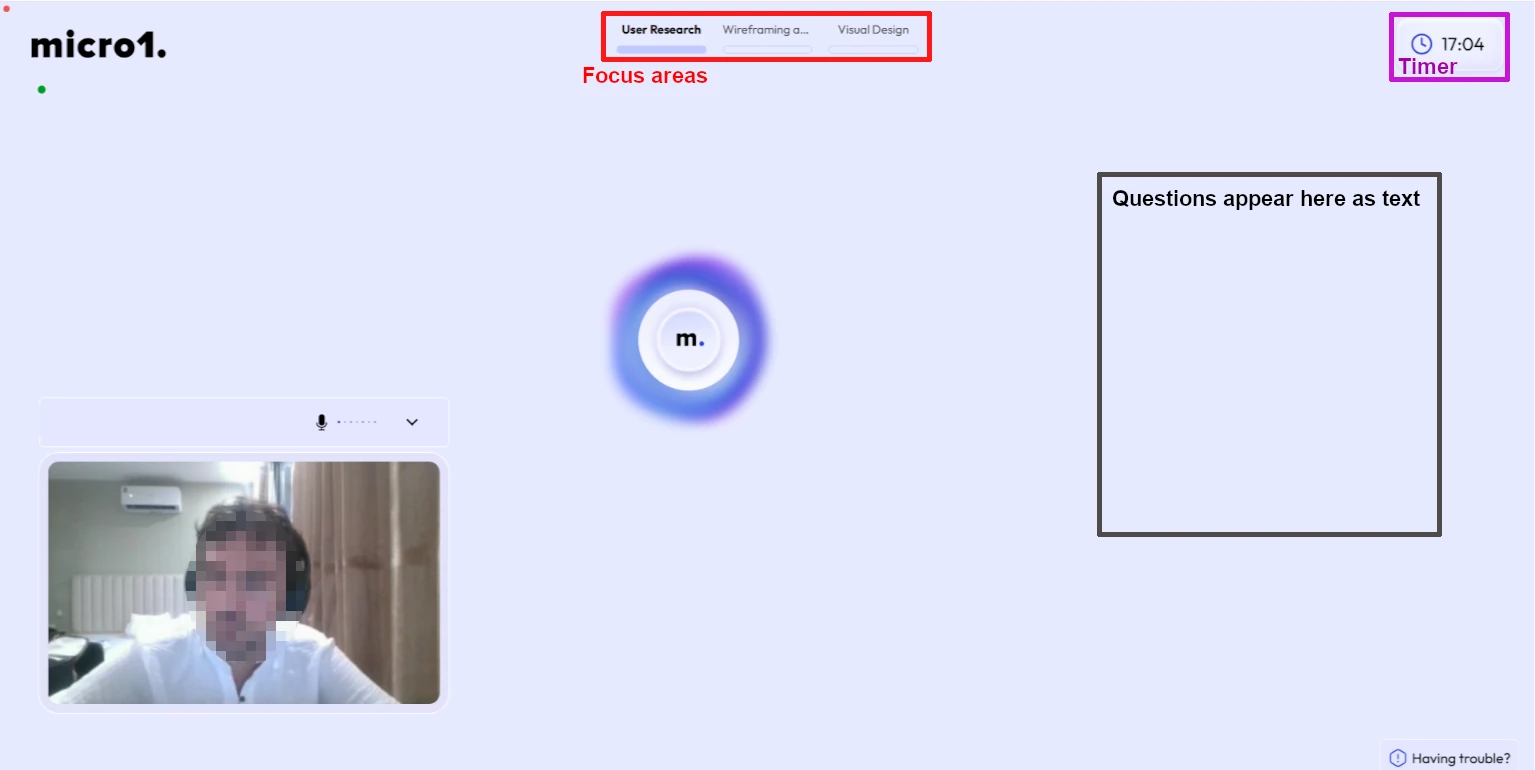
The layout tells you where you are the whole time. Labeled stages across the top, a countdown beside them, and the current question printed as text on the right while Zara speaks it. I read every question twice because it was sitting there, which is not something a phone screen with a human lets you do.
The moment that changed how I approached the real one was small. Zara asked about something I'd never done, so I told her I'd never done it. She reworded the question on the spot so I could answer for the skill sitting underneath it. A gap in my background turned into a different question instead of a blank. I went into the real interview knowing that was available if I needed it.
The real interview covered five focus areas in 28 minutes
The invite named the five areas up front: Decision Rationale, Critique & Evaluation, Synthesis Under Ambiguity, Communication For Non-Specialist Audiences, and Disagreement & Influence. They ran along the top of the screen during the interview the way the practice stages had, and I got roughly one question per area.
The length was on screen before I started: 28 minutes. Five areas across 28 minutes is about five minutes a question, and that matched the pace from the inside. Yours will probably say a different number, since it seems to be set by the role.
Reading that list before I clicked in did more for me than any other prep. Seeing Critique & Evaluation at the top of the screen told me a question wanted me to take something apart, not to tell a flattering story about myself. Without the label I'd have spent the first thirty seconds of each answer working out what was being asked.
The pacing held up across the whole thing. Nothing was rushed, I got to finish my thoughts, and I could tie every topic back to work I'd done even when the question hadn't asked for a project. It was an enjoyable interview, which I had not expected to write about a conversation with an AI.
I lost one question by thinking out loud
One got away from me. I have a habit of reading a question back out loud while I work out how to answer it, which in a human interview buys thinking time without looking like I'm stalling. Zara heard a finished turn, waited, and moved to the next question while I was still assembling the answer in my head.
It stung for about ten seconds. The next question landed in the same focus area, so I got most of that ground back anyway. If you need a moment, take it in silence, or say out loud that you need a few seconds. Filling the pause is what ends your turn.
Camera and screen-share stay on throughout
Micro1 wants your camera and a screen share for both the practice run and the real interview, on the whole way through rather than as a check at the start. It runs like a video interview, because that's what it is, with an AI on the other end of it instead of a person.
That's worth a few minutes beforehand: lighting, background, connection, and anything you might want to put on screen already open. Doing the practice run first is a free rehearsal of all of it on your own machine, at a point where nothing is riding on the result.
It asked how I work rather than what my CV says
Every question came off the five focus areas rather than off my history. Nobody asked me to walk through my career in order, and nothing opened with "tell me about a time." Each question put a problem in front of me, the sort the role would hand me in week one, and asked how I'd reason through it.
My experience still did most of the work. I grounded nearly every answer in something I'd run or shipped. The difference is that the question never asked for the example, so I had to reach for it myself. Have two or three projects loaded and ready before you start, and be willing to pull whichever one fits the question you got.
The result came in two emails, two days apart
I applied and finished both interviews on the afternoon of September 4th, 2026. The first email arrived the next day, the 5th: I'd performed well, and my profile was added to Micro1's vetted talent pool for the UX Designer Specialist role, now going through human review by a hiring manager. That message was direct that review doesn't guarantee placement, and that it can take up to 30 days.
A second email landed the day after that, the 6th: I was certified, with a certificate attached and a note to join Micro1's Discord community, which the email said is exclusive to certified talent. It also said they're now matching me with roles that fit my certified skills, that I can apply directly to other roles even outside those skills, and that my profile stays active for future openings either way.
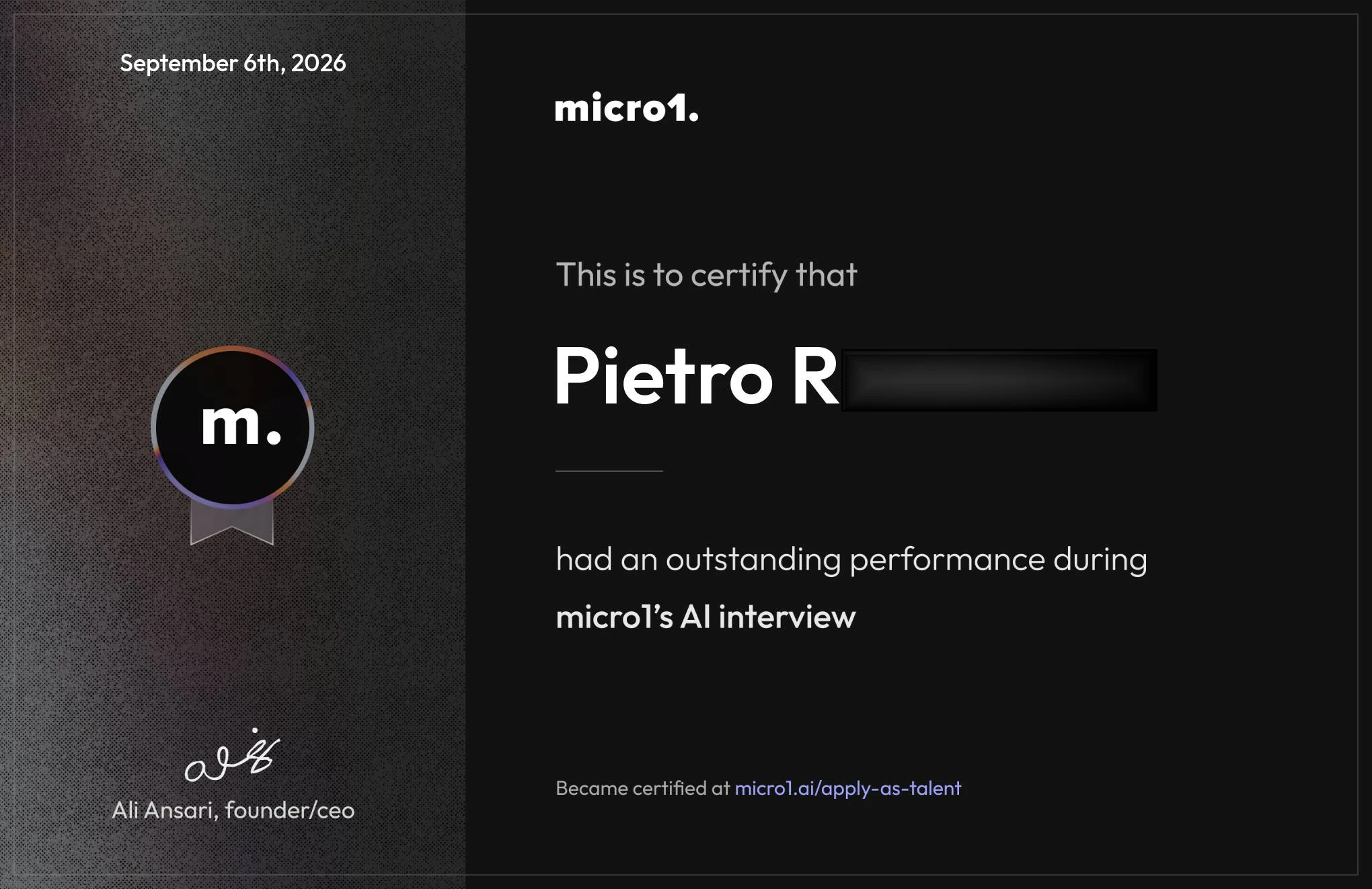
So certification and getting placed on a project are two different gates. The interview result gets you certified within a day or two. Being matched with an actual role sits behind that, runs through human review, and can take up to 30 days.
Update, September 15: it happened. Certified on the 6th, matched with an offer on the 15th, 9 days later, nowhere near the 30-day ceiling that first email warned me about. Micro1's talent operations team reached out directly with a project tied to the certification. I'm not getting into contract specifics here, but I'm thrilled about this one, and excited to see where it goes. If you've been sitting on the fence about taking this interview, take it as a real data point: certified→matched is not a hypothetical, and for me it moved fast.
If you're weighing up whether to bother: it's a single afternoon of work, the rehearsal means you know exactly what the real one feels like before it counts, and you find out where you stand inside a day. The open Micro1 roles are here.
One note if you're taking these AI interviews across a few platforms: this one is camera-on and built around the skills of the role, where the AskEthos call is voice-only and walks through your career history instead. Very different half hours.
FAQ
How long is the Micro1 AI interview? ▼
Mine ran 28 minutes, and the number was on screen before I clicked in, so I was not guessing at it. The practice run beforehand was about 15 minutes. The length seems to be set by the role you applied to, so go by what your own invite says rather than assuming 28.
Does Micro1 let you practice with a mock interview first? ▼
Mine did. I got a full practice run in the same interface before the real interview: same layout, same labeled progress bar, same on-screen question text, same camera and screen-share. It took about 15 minutes and it is the reason nothing in the real one caught me out.
Is the Micro1 AI interview only for developers? ▼
No. Zara is best known for coding and system-design screens, but I went through it as a UX researcher for a UX Designer Specialist role. My practice run was split into User Research, Wireframing, and Visual Design, and there was no code editor anywhere in it.
Does the Micro1 interview require a camera? ▼
Yes. Camera and screen-share were on for the whole of both the practice run and the real interview, not just for a check at the start. Treat it like any other video interview and sort out your lighting, background, and connection first.
What happens if you take too long to answer a Micro1 interview question? ▼
I found out. I read a question back out loud while I worked out my answer, Zara took that as my turn, and she moved on before I got to the answer. It did not wreck the interview, and the next question landed in the same focus area so I recovered most of the ground. If you need a second to think, think in silence or say out loud that you need a moment.
How long do Micro1 interview results take? ▼
Mine came in two parts. The first email landed the next day, roughly 24 hours after I finished: performed well, added to the vetted talent pool, now under human review by a hiring manager. The certification email followed a day after that, so two days total. Human review of the talent pool for an actual role match is the slower part, and that's the one the message said can take up to 30 days.
Does passing the Micro1 AI interview get you placed on a project? ▼
No. Passing gets you certified, which happened for me two days after the interview and came with a certificate and access to Micro1's Discord community for certified talent. Getting placed is a separate step behind that: your profile sits in the vetted talent pool, a human hiring manager reviews it, and that review can take up to 30 days with no guarantee at the end of it. You can also apply directly to roles yourself in the meantime, including ones outside the skills you're certified in.
What kind of questions does the Micro1 AI interview ask? ▼
Mine came off the five focus areas listed in my invite rather than off my CV. Each one handed me a problem the role would put in front of me and asked how I would reason through it. Nobody asked me to walk through my career in order, so I had to bring my own examples to the questions.
Related guides
Micro1 AI interview guide: the coding and system-design side of Zara, including the anti-cheat proctoring.
Micro1 review: full platform breakdown, pay rates, and who gets placed.
Micro1 profile optimization: how to move up the ranking buckets after you're verified.
My Ethos AI interview experience: another first-hand AI interview, voice-only and no camera.
Browse live Micro1 job listings: current openings updated regularly.
Cite this page
"My Micro1 (Zara) AI Interview Experience (2026)", aitrainer.work, aitrainer.work/guides/micro1-zara-interview-experience

MSc Human-Computer Interaction | Founder
Pietro is the founder and technical lead of aitrainer.work. He builds and maintains the platform's data pipeline, certification infrastructure, and editorial standards.